Category: Blog

Your blog category

  • Flipkart’s Big Billion Days Aerial Marketing: A Masterclass in Buzz

    Flipkart’s Big Billion Days Aerial Marketing: A Masterclass in Buzz

    Brand Marketing Masterclass

    Flipkart’s Aerial OOH Campaign in Bangaluru & Kanpur: Marketing From 30,000 Feet

    Share This Article

    Author: Akash Gupta | AI Generalist & Content Specialist, Fresio Media
     India — September 24, 2025

    Flipkart’s Crop Circle Campaign Is The Future Of Marketing

    For years, brands fought for billboard space. They spent millions on TV commercials. Now, Flipkart has gone in a completely different direction. It chose the sky.

    The e-commerce giant created massive crop circle installations. They are only visible from thousands of feet up. This aerial marketing stunt for their Big Billion Days sale has everyone talking. It’s a masterclass in modern marketing.

    This isn’t about impressions. It’s about creating a moment. It’s about generating a story people want to share. This article breaks down why this bold move is a glimpse into the future of advertising.

    Want to build a talk-worthy brand? Let’s discuss a strategy that goes beyond the usual. Let’s Talk!

    Key Takeaways

    • Flipkart’s campaign is not about direct reach, but about creating buzz and earned media.

    • The stunt proves that unexpected, experiential marketing can have a higher ROI than traditional ads.

    • This approach is a lesson for all brands: innovate with your perspective, not just your budget.


    Table of Contents

    • What Is Aerial OOH Marketing?

    • The Strategy Behind Flipkart’s “Talk-Worthy” Campaign

    • ROI Beyond Impressions: The Power of Earned Media

    • The Future of Advertising Is Experiential

    • How Smaller Brands Can Learn From This

    • The Big Billion Days Case Study: Turning Farmlands Into Billboards

    • Common Mistakes Brands Make With Viral Marketing

    • Frequently Asked Questions (FAQs)

    • Conclusion


    What Is Aerial OOH Marketing?

    Aerial Out-of-Home (OOH) marketing uses the sky as a canvas. This can include billboards on blimps or skywriting. It’s a type of guerilla marketing. It grabs attention in a big way.

    In short: Aerial OOH is a non-traditional marketing method that uses the sky or airspace to display advertisements.

    Flipkart’s campaign is India’s first aerial OOH stunt. It is designed for airline passengers. The installations were placed near Bengaluru and Kanpur airports. This targets a specific, high-value demographic.

    “This is a first-of-its-kind campaign,” said a Flipkart spokesperson. “It’s about turning the mystery of crop circles into magic, which truly embodies the spirit of our ‘Kuch Bhi Ho Sakta Hai’ tagline for the Big Billion Days.”

    Source: The Economic Times, September 20, 2023

    This quote confirms the strategic intent. The campaign is about magic and possibility. It directly links the a-ha moment to the brand’s core message.

    The Strategy Behind Flipkart’s “Talk-Worthy” Campaign

    Flipkart did not create this for direct sales. They did it for buzz. The goal was to create a moment. Something people would share and discuss.

    In short: The core strategy was to bypass traditional advertising channels and generate free, organic media coverage and social sharing.

    The campaign’s success is not measured in eyeballs. It’s measured in media mentions. It’s about social shares and public conversation. Every article written and every tweet shared becomes free advertising. This is called earned media.

    This approach is highly effective. It builds brand reputation and cultural relevance. It makes a brand seem innovative and clever. This is a crucial element of modern marketing.

    ROI Beyond Impressions: The Power of Earned Media

    The return on investment (ROI) here is not from direct clicks. It’s from a broader impact. The campaign’s true value lies in its earned media.

    In short: Earned media is unpaid publicity generated by public relations efforts, social media, and word-of-mouth.

    This campaign was designed to be a story. A story the media wanted to cover. A story people wanted to talk about. The small number of travelers who saw it are a bonus. The real prize is the millions who heard about it.

    Consider this: A single article in a major publication can reach millions. A viral social media post can reach millions more. All of this for the cost of a few crop circles. This is a far better return than a traditional billboard.

    The Future of Advertising Is Experiential

    The Flipkart campaign shows a major shift. Brands are moving from “What we sell” to “What we do.” They are creating experiences. These experiences are what build strong connections with customers.

    In short: Advertising is evolving from simple messaging to creating memorable, shareable brand experiences that resonate with audiences.

    The goal is not to sell a product. It is to build a feeling. Red Bull is a perfect example. They don’t just sell energy drinks. They sponsor extreme sports events. This associates their brand with adventure and daring.

    This type of marketing builds brand loyalty. It makes customers feel part of a community. It creates a story that they can become a part of.

    How Smaller Brands Can Learn From This

    You don’t need a massive budget to learn this lesson. The principle is the same. Think about what is unexpected in your industry.

    In short: Smaller brands should focus on creating unexpected, creative actions that generate buzz without requiring a huge budget.

    Find a small, unique way to stand out. Can you do something different at a local event? Can you create an online challenge? Can you partner with a local artist?

    Innovation is about perspective. It’s not always about money. For example, a local bakery could bake a giant cake for a public festival. They could document the process online. This creates a memorable moment. It gets people talking. And it costs far less than a TV ad.

    The Big Billion Days Case Study: Turning Farmlands Into Billboards

    The Flipkart campaign was genius. It was located on farmlands. Near the approach and departure paths of two major airports. The crop circles were intricate. They featured the Flipkart logo and the “Big Billion Days” text.

    The stunt was planned for maximum impact. It was timed to coincide with a major travel season. It was designed to intrigue. People on planes would see it and wonder. That sense of mystery is what makes people talk.

    The campaign’s tagline, “Kuch Bhi Ho Sakta Hai” (Anything is possible), was perfectly tied to the visual. The unexplainable crop circles were a physical representation of the slogan.

    This campaign is a classic example of guerilla marketing. It is low-cost, high-impact. It relies on creativity and surprise. It proved that you don’t need to shout the loudest. You just need to be the most interesting.

    Common Mistakes Brands Make With Viral Marketing

    • Focusing on Shock Value: Creating a controversial stunt just for attention can backfire. It can alienate your audience and damage your brand reputation.

    • Forgetting the Brand: The stunt must be aligned with your brand message. Flipkart’s stunt was tied to their tagline.

    • No Follow-Through: A viral campaign needs a plan. You need to leverage the buzz. Have a clear call-to-action or follow-up content ready.

    • Underestimating the Cost: While creative, these stunts are not free. Don’t go into it without a solid budget plan.

    • Ignoring Measurement: Even with earned media, you must track results. How many shares? How many media mentions? What is the sentiment?

    Frequently Asked Questions (FAQs)

    Q: What is the Flipkart crop circle campaign? 

    In short: The Flipkart crop circle campaign was an aerial marketing stunt for their Big Billion Days sale, where they created large, logo-shaped formations on farmlands near airports in Bengaluru and Kanpur to be seen by air travelers.

    A: The campaign was a highly unusual form of Out-of-Home (OOH) advertising. Instead of traditional billboards, Flipkart utilized farmlands to carve out massive crop circles featuring its branding. These were strategically placed beneath flight paths, ensuring visibility to thousands of people flying in and out of two of India’s busiest airports. The primary goal was not direct sales but to generate widespread media and social buzz, positioning the brand as innovative and creative.

    Q: Why did Flipkart use crop circles for advertising? 

    In short: Flipkart used crop circles to create an unexpected, mysterious, and highly shareable moment that would generate free media coverage and social buzz far beyond the few people who saw it directly.

    A: The decision to use crop circles was a deliberate strategic choice to create a “talk-worthy” event. By tapping into the intrigue and mystery associated with crop circles, Flipkart made a memorable statement. This campaign’s success isn’t measured by the number of travelers who saw the ad but by the millions of people who read about it in newspapers, saw it on social media, and discussed it online. It was a calculated move to secure earned media.

    Q: Is this type of marketing effective? 

    In short: Yes, this type of experiential and buzz-driven marketing is highly effective because it builds brand reputation and cultural relevance by generating powerful word-of-mouth and earned media, which often has a higher ROI than paid advertising.

    A: This approach is incredibly effective for large brands that want to create a narrative and a cultural moment. While traditional ads can be easily ignored, a unique stunt like this becomes a story. It generates trust and interest, leading to increased brand loyalty and consideration. It’s a shift from “advertising at people” to “creating something people want to be a part of and share.”

    Q: How does this campaign compare to traditional OOH advertising? 

    In short: Unlike traditional OOH which focuses on reaching a local audience with a static message, Flipkart’s aerial OOH campaign used a physical installation to trigger a massive digital and media conversation, with the goal being earned media, not just impressions.

    A: Traditional OOH, such as billboards, aims for high visibility and repeated exposure to a local audience. Its success is measured by impressions and direct action. In contrast, Flipkart’s campaign had a limited direct audience. Its true power was in its novelty. It was a one-off event designed to be photographed, shared, and amplified by digital media, giving it a global reach far beyond its physical location.

    Q: Can smaller brands do something similar? 

    In short: Smaller brands can’t replicate the scale of the Flipkart campaign but can adopt the underlying principle of creating an unexpected, memorable, and shareable moment within their own niche and budget.

    A: Absolutely. The core lesson is to think creatively. A small coffee shop could organize a “reverse graffiti” art project by cleaning a dirty wall in the shape of their logo. A local gym could hold a surprise fitness flash mob in a public park. The principle is the same: do something unexpected, make it easy to share online, and tie it back to your brand’s message. Innovation is about perspective, not just scale.

    Conclusion

    Flipkart’s aerial campaign is a bold statement. It shows where marketing is headed. It’s a move away from shouting the loudest. It’s a shift toward creating the most interesting story. The campaign’s success proves that a unique idea is more valuable than endless ad spend. The future of marketing is not about just reaching people. It’s about giving them something to talk about.

    Ready to create a campaign that breaks through the noise? Talk to us today.

    Sources & Backlinks

    1. “Flipkart’s Big Billion Days campaign takes to the skies with first-of-its-kind aerial marketing” — The Economic Times Brand Equity — September 20, 2023 — https://brandequity.
      economictimes.indiatime
      s.com/news/advertising/
      flipkarts-big-billion-days-campaign-takes-to-the-skies-with-first-of-its-kind-aerial-marketing/103823793

    2. “Flipkart’s Big Billion Day 2023 campaign takes over farmlands to create ‘crop circles’” — Financial Express — September 20, 2023 — https://www.financial
      express.com/business/
      e-commerce-flipkarts-big-billion-day-2023-campaign-takes-over-farmlands-to-create-crop-circles-3253670/

    3. “Flipkart turns farmlands into billboards for its Big Billion Days campaign” — Business Insider India — September 21, 2023 — https://www.business
      insider.in/advertising/
      brands/article/flipkart-turns-farmlands-into-billboards-for-its-big-billion-days-campaign/articleshow
      /103833214.cms


    Read Our Blogs

    • All Posts
    • Blog
    • Real Estate
    • SEO Mastery Series
      •   Back
      • Artificial Intelligence Mastery Series
      • Real Estate Guide Series
      • India Series
      • Brand Marketing Masterclass
      •   Back
      • Real Estate Lead Generation
      • Real Estate Digital Marketing
    Load More

    End of Content.

    FresioMedia.

    Get In Touch

    E-Mail: contact@fresiomedia.com
    Phone: +91 96740 06129

    All Rights Reserved by Fresio Media.
  • How to Get Free Real Estate Leads (10 Step-By-Step Proven Methods)

    How to Get Free Real Estate Leads (10 Step-By-Step Proven Methods)

    Real Estate Digital Marketing

    10 Free Real Estate Lead Generation Methods (2025): A Step-by-Step Guide with Checklists & Templates

    Share This Article

    Published: September 13, 2025


    Overview

    Free real estate leads can be generated by leveraging organic channels like local listing platforms, social media, community networking, and creating high-value educational content without paying for ads.

    Generating free real estate leads involves building a sustainable pipeline through strategic, non-paid efforts.

    Key methods include optimizing your presence on free real estate listing sites and Google Business Profile to capture active searchers.

    You should also build your personal brand on social media platforms like Instagram and LinkedIn by sharing valuable content and engaging with your community.

    Additionally, effective strategies include leveraging instant messaging platforms like WhatsApp for direct communication, networking with local businesses, and implementing a robust referral program to tap into warm leads.

    By consistently creating educational content and maintaining an email list, you can establish yourself as a trusted local expert, attracting a continuous flow of prospects for little to no cost.

    1) Leverage free real estate listing sites (99acres / MagicBricks / Housing / OLX / NoBroker)

    Goal: get enquiries from people actively searching property listings — for free.

    Step-by-step

    1. Choose 2–4 portals to target. Pick the major ones used in your market (e.g., 99acres, MagicBricks, Housing, OLX). Start with the busiest two and expand. 99 Acres+1

    2. Create and verify accounts. Use a business email and phone number. Upload business logo and a short bio/credentials.

    3. Gather assets before listing: 8–15 high-quality photos (exterior, every major room, floor plan), a short walk-through video (30–90s), accurate dimensions, certificate scans (if allowed), nearby landmarks, and a map pin.

    4. Write a headline + 3–5 bullet summary:

      • Headline: 3BHK — 1,200 sqft | [Neighbourhood] | Near Metro

      • Bullets: bedrooms, price, parking, ready to move/in possession, special features (balcony, terrace, lift).

    5. Full description with local SEO: mention the neighbourhood, schools, metro/station names and the exact locality — these are search keywords buyers use. Keep price and contact info prominent. 99 Acres

    6. Set contact & lead capture: Select your phone number + email; enable platform enquiry notifications (SMS, email, app alerts). If portal lets you add a website or WhatsApp link, do it.

    7. Add tags & amenities: Use all applicable checkboxes (floor, furnishing, amenities) — those filters bring search traffic.

    8. Post & “refresh” strategically: Many portals show newer posts first. Repost or update images/descriptions every 7–21 days (follow site rules). 99 Acres

    9. Respond within 15–30 minutes: quick replies dramatically improve conversion. Use canned reply templates for common questions (see templates below). Privyr

    10. Track & follow up: Log each enquiry into a free CRM or spreadsheet (source, date, contact, status). Mark follow-ups and set reminders.

    Checklist (what you need)

    • Camera or good phone, measured floor plan, property docs (if allowed), 8–15 photos, short video, business email, phone, free CRM (HubSpot free CRM recommended). HubSpot

    Canned reply template (first reply)

    Hi [Name], thanks for enquiring about [3BHK, Neighbourhood]. The home is ready to move, ₹[price]. Can I call you at [time]? I can also share a short walkthrough video and schedule a visit this week.

    Why this works: portals have huge active searchers; good photos + quick responses win. 99 Acres+1


    2) Organic social media (Instagram, Facebook, LinkedIn, YouTube)

    Goal: attract and convert searchers & followers without ad spend.

    Step-by-step

    1. Clarify your content pillars (3–4): e.g., listings, neighbourhood guides, market data, client stories / testimonials.

    2. Optimize profiles: business name, consistent NAP (name/address/phone), website link (use a simple landing page with property alerts), branded profile image, contact buttons (call / WhatsApp).

    3. Schedule content: 3 posts/week + daily Stories (IG/Facebook) + 1 video (YouTube/short) per week. Use a free scheduler (e.g., Later free plan).

    4. Local-first posts: always add location, local hashtags and local phrases (e.g., “[Colaba] 2BHK under ₹1.2cr”). Geotag posts to appear in local searches.

    5. Show social proof: share short client videos, before/after staging, screenshots of 5★ reviews (with permission).

    6. Interactive formats: run polls (Instagram/Facebook), host a live virtual open house and promote it 48–24 hours before. Use the Live to capture comments and DM attendees afterward. Building Better Agents

    7. DM funnel & CTA: use a pinned post that explains how to join your property alerts (DM a keyword like “ALERT”), then add those contacts to an email or WhatsApp list (with consent).

    8. Repurpose content: convert a 5-minute market video into a 60-sec reel, a LinkedIn post, and a blog excerpt.

    9. Measure simple KPIs: profile visits, direct messages, leads captured (spreadsheet/CRM). Iterate on top-performing post types.

    Tools & templates

    • Tools: free Canva for visuals, free Later/Hootsuite plan, YouTube (free), Linktree or simple landing page for signups.

    • DM script to capture lead:

      Hi [Name] — thanks for following! Are you looking to buy or rent in [area]? If yes, share a budget and preferred move-in date and I’ll send matching listings daily.

    Why this works: organic social builds trust and a pipeline of warm prospects when you combine value content + lead capture CTAs. Building Better Agents


    3) WhatsApp & Telegram communities (chat funnels + automation)

    Goal: convert inquiries quickly and nurture leads using instant messaging.

    Step-by-step

    1. Install WhatsApp Business and create a business profile (logo, hours, website, address) or use the WhatsApp Business API for automation if you scale. respond.io+1

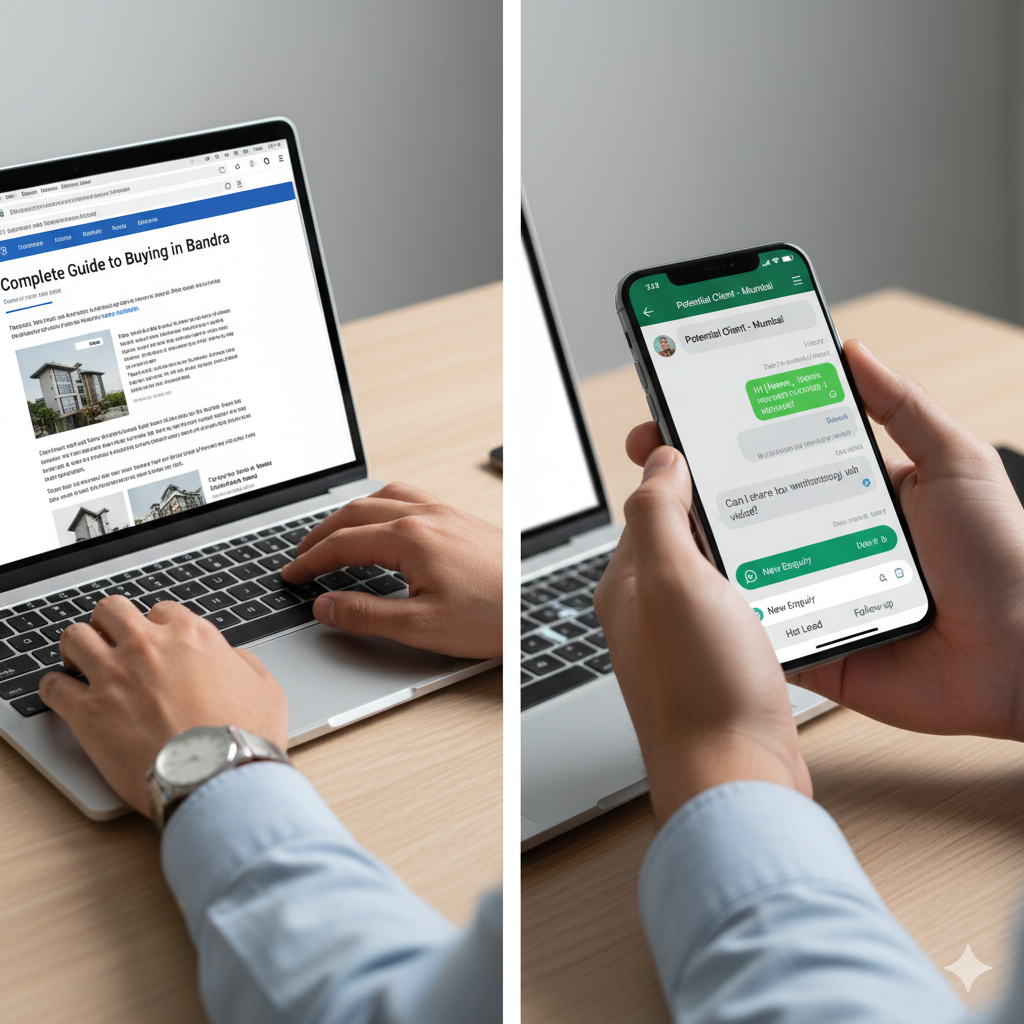
    2. Create message templates & automations: set “away” messages, greeting messages, and quick reply templates (labels: new enquiry, hot, follow-up).

    3. Add Click-to-WhatsApp & QR codes everywhere: website, Google Business Profile, social posts, printed flyers, For Sale signs. Use Facebook “Click-to-WhatsApp” ads if you later choose ads. cuedesk.com

    4. Build segmented lists: use broadcast lists only for contacts who saved your number (WhatsApp limitation). Segment by buyer/seller/area.

    5. Lead magnet via WhatsApp: offer a one-page “Local Market Snapshot” PDF or a free 15-min consult. People message you to get the PDF; add them to a nurture flow.

    6. Use chatbots for qualification (optional): set a first step bot to capture budget, timeline, and preferred locality before routing to you. Tools: AiSensy, BotPenguin, respond.io integrations. AiSensy+1

    7. Follow up schedule: immediate automated reply → 24-hour personal message → schedule call/visit within 3 days. Keep a 7-day and 21-day touchpoint if not ready.

    8. Privacy & consent: always get opt-in before adding people to lists; don’t spam. Keep templates short and useful.

    Templates (WhatsApp)

    • Greeting: Hi [Name], thanks for reaching out about [Property]. Do you prefer a quick call or should I send a short walkthrough video first?

    • Qualification (bot/manual): Budget? Bedrooms? Move-in timeframe? Best time to call?

    Why this works: response speed and the personal nature of WhatsApp convert enquiries fast — use automation to scale. respond.io+1


    4) Google Business Profile (GBP) — free local visibility

    Goal: show up in “near me” and map searches and capture local intent leads for free.

    Step-by-step

    1. Create / claim profile at Google Business Profile manager and pick the right category (“Real Estate Agent” vs “Real Estate Agency”). Verify by postcard or phone if available. AgentFire+1

    2. Complete all fields: NAP (consistent), hours, service areas, phone, website, appointment URL, business description (include neighbourhood keywords).

    3. Add 12+ photos: hero photo, team shots, office, listings, neighborhood images. Add a short 30-60s video if possible.

    4. Use GBP Posts weekly: post open houses, new listings, market updates; include CTA like “View photos” or “Book visit”.

    5. Get reviews: ask clients to leave a review (send link). Reply to reviews politely (thank positive reviewers; answer concerns on negative ones). Reviews boost clickthroughs.

    6. Enable messaging & bookings: if available in your region, enable messaging so prospects can message you directly from Search.

    7. Monitor GBP Insights: track calls, direction requests and website clicks to see what neighbourhoods are responding. Optimize content accordingly. contempothemes.com+1

    Quick checklist

    • Claim profile, verify, add photos, post weekly, request reviews from clients.

    Why this works: GBP drives local intent traffic — people searching “real estate agent near me” are often ready to act. AgentFire


    5) Network offline & local partnerships

    Goal: get lead introductions from real people and local businesses without online ad spend.

    Step-by-step

    1. Identify local touchpoints: builders, conveyancers, mortgage brokers, interior designers, relocation consultants, major employers, community groups.

    2. Prepare a partnership kit: one-pager (print + PDF) that explains what you do, a QR code to sign up for property alerts, and sample client testimonials.

    3. Attend & host events: sponsor/attend local chai/coffee mornings, community association meetings, builder launches, or host a free home-buying seminar at a library or coworking space. Collect emails and phone numbers on a sign-in sheet (with consent).

    4. Create co-marketing offers: ask a mortgage broker to co-host an event; they promote to their clients and you get access to their audience.

    5. Door-knock smartly (if allowed): bring a one-page neighbourhood market update and a QR signup; keep interactions short and valuable.

    6. Referrals from tradespeople: keep a referral card program for plumbers, electricians and interior people — give a small thank-you for qualified leads.

    Scripts & follow up

    • At event: Hey, I help [area] families buy with under 3% deposit—can I add you to my weekly property alert?

    • After meeting: email within 24 hours with a link to a signup page and a one-page market snapshot.

    Why this works: local trust and word-of-mouth still convert better than cold online leads in many markets.


    6) Create educational content (blogs, YouTube, guides)

    Goal: become the trusted local expert so buyers/sellers opt in — long term organic free leads.

    Step-by-step

    1. Pick high-intent topics: “How to buy in [Neighbourhood] 2025”, “Property taxes in [City] explained”, “How much stamp duty / charges?” — use your own market experience and local search queries.

    2. Do basic keyword research: free tools — Google autocomplete, Related searches, AnswerThePublic, and the free sections of Ubersuggest. Target 1 primary keyword (e.g., “free real estate leads” for a general post) and 3–5 supporting phrases.

    3. Create content formats: long form blog (1,200–1,800 words), short FAQs, 5–10 minute YouTube walkthroughs, downloadable checklist (“10 Steps to Inspect an Apartment”).

    4. Add lead magnets: gate a PDF guide behind an email capture — “Download the [Neighbourhood] Buyer Guide → enter email to receive”. Put the same CTA on social and GBP.

    5. On-page SEO basics: clear H1, 2–3 H2s, internal links to your listings, alt text on images, and descriptive filename for images (e.g., “bandra-2-bhk-balcony.jpg”).

    6. Promote: post on social, add to your newsletter, share in relevant local groups and answer relevant Quora threads with a link back.

    7. Measure: organic traffic, time on page, email signups from the post.

    Blog outline example (1,500 words)

    • H1: Complete Guide to Buying in [Neighbourhood]

    • H2: Why buyers love [neighbourhood]

    • H2: Typical prices and what to expect

    • H2: Step-by-step buying process

    • CTA: Download the free checklist (email capture)

    Why this works: educational content builds organic search traffic and gives a justifiable reason to ask for contact details (lead magnet).


    7) Referral systems (clients, vendors, past buyers)

    Goal: get warm leads from people who already trust you.

    Step-by-step

    1. Create a simple referral program: an email template, thank-you gift, or small gift voucher for each successful referral (respect local laws on incentives).

    2. Ask at the right times: after a closing, after a referral, or after a strong positive interaction. Timing: within 24–72 hours of delighted client feedback.

    3. Provide tools to refer: email template, shareable WhatsApp message, or a referral landing page where the referee fills one short form.

    4. Track referrals: add a “referred by” field in your CRM. Follow up within 24 hours of referred contact arriving. Use HubSpot free CRM or similar to log and automate follow-ups. HubSpot

    5. Say thanks publicly & privately: a public social post that thanks a referrer (with permission) and a private handwritten note or small gift.

    Referral ask script (after closing)

    I’m really glad we found the right home. If you know anyone else looking in [area], would you mind introducing us? A quick text or WhatsApp will do — and if it converts I’ll send a small thank-you.

    Why this works: warm leads from friends/family convert faster and cost nothing.


    8) Free classified sites (OLX, Quikr, Craigslist) — similar to portals but broader reach

    Goal: reach bargain-hunters, FSBOs and apartment hunters who browse classifieds.

    Step-by-step

    1. Pick platforms used in your area (OLX and Quikr in India; Craigslist in the US). Create an account and verify. OLX India+1

    2. Use a clean, upfront ad title: 2BHK Flat for Sale — [Neighbourhood] — ₹[price]

    3. Upload good photos & mention dimensions: classifieds often have many low-quality postings — quality differentiates you.

    4. Provide clear contact instruction: “Message on WhatsApp at [number]” or “Call [number] between 10am–6pm”.

    5. Avoid sensitive personal documents: never upload PAN, Aadhaar or full property registry. Keep safety in mind and encourage in-person verification. (Be cautious — classifieds see scams; meet in public, verify identity.) The Times of India+1

    6. Monitor & renew: reply fast; use “promote” features only if you later want paid boosts.

    Sample ad (short)

    2BHK, 950 sqft, Juhu — ₹1.6 Cr. Lift, Parking, Near school & metro. Photos & floor plan attached. WhatsApp for walkthrough video: [number].

    Why this works: classifieds have high volume and are free — but expect more low-quality enquiries; vet fast.


    9) Q&A sites & local forums (Quora, Reddit, local Facebook groups)

    Goal: build authority and capture interested searchers by answering questions.

    Step-by-step

    1. Create a profile that says who you are (title: “Real estate agent — [City]”) and include website/CTA.

    2. Find relevant topics: follow tags like “real estate”, “buying a house in [city]”, or the subreddits and local community groups.

    3. Answer with value, not a sales pitch: provide a helpful, thorough answer (400–800 words) and then add a short CTA: “If you want a free local checklist, DM me or download here.” Use UTM links to track clicks. StoryChief+1

    4. Repurpose answers: turn long answers into a blog post or video and link back.

    5. Track conversions: use a landing page for downloads so you can capture email/phone.

    Answer template (Quora / Reddit)

    • Start with a short one-line summary, then 3–5 concrete steps, and close with a CTA to a free guide or direct message.

    Why this works: Q&A builds organic authority and puts you in front of people actively researching — high intent and free.


    10) Email marketing & property alerts (the highest ROI channel)

    Goal: convert warm leads into appointments and nurture cold leads into future clients — low cost, high ROI.

    Step-by-step

    1. Build an email list ethically: collect emails from portal enquiries, social signups, event signups, and landing pages — always with consent.

    2. Pick a free email tool / CRM: HubSpot free CRM (works with email campaigns) or Mailchimp’s free plan. HubSpot offers a robust free CRM for lead tracking. HubSpot+1

    3. Segment your list: buyers by budget & area, sellers by ownership & timeline, investors by ROI interest.

    4. Create three automated flows:

      • Welcome flow: immediate thank-you + what to expect (3 emails over 7 days).

      • Property alert flow: weekly digest with 3–5 new listings matching their filters.

      • Nurture flow for long leads: monthly market update + 1 CTA for a call.

    5. Write high-opening subject lines: e.g., New 2BHK near [Station] — ₹[price] or Your weekly local market snapshot — [Neighbourhood]

    6. Follow deliverability best practices: double opt-in, clean lists, plain text fallback, and test sends. Email ROI is strong — industry sources report average ROI of ~$36 for every $1 spent — email remains a top converting channel. DemandSage+1

    7. Measure KPIs: open rate, click rate, replies, appointments booked; bring leads into CRM and mark outcomes.

    Sample 3-email welcome flow

    • Email 1 (immediate): Welcome + link to top 3 matching properties.

    • Email 2 (2 days): “How the buying process works in [city]” + CTA to schedule a 15-min call.

    • Email 3 (7 days): Social proof — short testimonial + reminder to set preferences.

    Why this works: email is low-cost and extremely effective for nurturing and repeat contact — especially when combined with property alerts. DemandSage+1


    Tools cheat-sheet (free or freemium)

    • Free CRM: HubSpot free CRM (contacts, tasks, basic email sequences). HubSpot

    • Listing portals: 99acres, MagicBricks, Housing, OLX (India) — use platform help pages to post correctly. 99 Acres+1

    • Messaging / Chat: WhatsApp Business (app/API), AiSensy/BotPenguin for chatbots / automation. AiSensy+1

    • Content & design: Canva (free), YouTube (free hosting), Linktree (free).

    • Scheduling & lists: free Later / Buffer tiers, Google Sheets.

    • Email: HubSpot free emails or Mailchimp free plan. HubSpot


    Final checklist — what to implement in Week 1

    1. Claim/verify Google Business Profile. AgentFire

    2. Post 1 listing on 2 major portals (99acres + OLX) with 8+ photos. 99 Acres+1

    3. Set up WhatsApp Business and a Click-to-WhatsApp link. AiSensy

    4. Create a simple landing page + lead magnet and connect it to HubSpot free CRM. HubSpot

    5. Publish 1 educational post + share in 2 local FB/WhatsApp groups.


    A few last tips & warnings

    • Speed matters: respond to portal/WhatsApp enquiries within 15–30 minutes whenever possible — response time correlates with conversion. Privyr

    • Safety first: in public classifieds and social media, verify buyers and never share sensitive documents; meet in public places and always confirm identity. There are scam reports on marketplaces — be vigilant. The Wall Street Journal+1

    • Track everything: even a shared Google Sheet is better than nothing — record source, contact, budget and next step


    Frequently Asked Questions

    1. How long does it take to get free real estate leads? 

    You can start getting inquiries from listing portals within a day, but building a consistent, high-quality lead flow through organic social media or content can take 3-6 months.

    2. What is the most important first step for a new agent? 

    The most crucial first step is to claim and fully optimize your Google Business Profile, as this immediately increases your local search visibility for ready-to-act buyers.

    3. Do free classified sites like OLX work? 

    Yes, they can work, but expect a higher volume of low-quality or scam inquiries. It is essential to vet leads quickly and prioritize safety.

    4. Should I pay for a CRM? 

    No, you don’t need to. Start with a free CRM like HubSpot, which offers robust features for contact management, email tracking, and basic lead nurturing.

    5. How often should I post on social media? 

    A good starting point is 3 posts per week plus daily stories on Instagram and Facebook, along with one longer video on a platform like YouTube each week.

    6. Is it better to focus on a few methods or all of them? 

    Start by mastering 2-3 methods, like listing portals and Google Business Profile, before gradually expanding to others like content creation and networking.

    7. Can I generate leads without social media? 

    Yes, you can. Methods like email marketing, offline networking, and paid search ads (which are not free) can be effective alternatives if social media is not a good fit for you.

    8. How do I get clients to leave me reviews? 

    Ask your clients for a review right after a successful closing, when they are happiest. Make it easy by sending a direct link to your Google Business Profile review page.

    9. How do I handle scams on free platforms? 

    Be vigilant: never share personal documents like PAN or Aadhaar, meet clients in a public place for the first time, and trust your instincts.


    Sources & Backlinks


    1. 2023 Real Estate in a Digital Age Report — National Association of Realtors (NAR) — 2023 — https://www.nar.realtor/
      research-and-statistics/research-reports/real-estate-in-a-digital-age

    2. Digital Advertising & Trust Survey — Statista — 2024 — https://www.statista.com/
      chart/2065/digital-advertising-trust/

    3. The Ultimate Guide to Google My Business for Real Estate Agents — AgentFire — https://agentfire.com/real-estate-marketing-blog/the-ultimate-guide-to-google-my-business-for-real-estate-agents/

    4. State of Inbound Report — HubSpot — 2024 — https://www.hubspot.com/
      state-of-inbound

    5. Help pages for posting on 99acres — 99 Acres — https://www.99acres.com/
      help.php

    6. The 2024 Real Estate Agent’s Guide to Using WhatsApp — Privyr — https://www.privyr.com/
      blog/whatsapp-guide-for-real-estate-agents

    7. Social Media Marketing For Real Estate Agents — Building Better Agents — 2024 — https://buildingbetter
      agents.com/blog/social-media-marketing-real-estate-agents

    8. Using WhatsApp for Real Estate Agents — Respond.io — https://respond.io/blog/
      whatsapp-for-real-estate-agents

    9. The Power of Word-of-Mouth Marketing — The Wall Street Journal — 2023 — (Paywalled)

    10. Help Center — OLX India — https://help.olx.in/

    11. Online fraud: Cops warn against sharing personal information — The Times of India — January 2023 — https://timesofindia.
      indiatimes.com/city/
      mumbai/online-fraud-cops-warn-against-sharing-personal-information/articleshow/
      97354924.cms

    12. How to use Quora for Business — StoryChief — https://storychief.io/blog/
      quora-for-business

    13. Email Marketing ROI Statistics & The Best Email Marketing Services — DemandSage — https://www.demandsage
      .com/email-marketing-roi-statistics/


    About the Author

    Akash Gupta
    LinkedIn: https://www.linkedin.com/in/
    contentwriterakashgupta

    Read Our Blogs

    • All Posts
    • Blog
    • Real Estate
    • SEO Mastery Series
      •   Back
      • Artificial Intelligence Mastery Series
      • Real Estate Guide Series
      • India Series
      • Brand Marketing Masterclass
      •   Back
      • Real Estate Lead Generation
      • Real Estate Digital Marketing

    Read Our Other Blogs

    • All Posts
    • Blog
    • Real Estate
    • SEO Mastery Series
      •   Back
      • Artificial Intelligence Mastery Series
      • Real Estate Guide Series
      • India Series
      • Brand Marketing Masterclass
      •   Back
      • Real Estate Lead Generation
      • Real Estate Digital Marketing

    FresioMedia.

    Get In Touch

    E-Mail: contact@fresiomedia.com
    Phone: +91 96740 06129

    All Rights Reserved by Fresio Media.
  • Trump Likely to stop IT Outsourcing: A Crisis or Catalyst for India’s Tech Sector?

    Trump Likely to stop IT Outsourcing: A Crisis or Catalyst for India’s Tech Sector?

    INDIA

    Trump Likely to stop IT Outsourcing: A Crisis or Catalyst for India’s Tech Sector?

    The potential US policy shift on IT outsourcing is a major threat to India’s economy and its technology sector. This policy, if enacted, could be a significant setback, but it also provides a unique opportunity for India to change its strategic focus from external dependence to internal development.

    The proposed block on IT outsourcing would have a severe and immediate impact. The country’s IT industry, valued at over $300 billion, is heavily reliant on US contracts.

    An official block would directly threaten this sector.
    This could lead to widespread job losses for technical, support, and backend operations in India.

    US companies would have to localize their call centers and IT jobs. This would disrupt their cost structures. It could also reduce their global competitiveness.

    For India, this would mean a significant loss of foreign revenue.
    It would also lead to a rise in unemployment among a highly skilled workforce.

    The threat has already caused major anxiety within India’s tech sector. Entrepreneurs and professional associations are closely monitoring the situation.

    Key Takeaways

    • The proposed US block on IT outsourcing could severely damage India’s $300 billion IT sector and lead to mass job losses.

    • India’s government and industry leaders are stepping up engagement with US firms to mitigate the fallout.

    • This crisis is also an opportunity for India to pivot from being an outsourcing hub to developing its own domestic technology ecosystem.

    Table of Contents

    1. What is the proposed US policy on IT outsourcing?

    2. Why this policy matters now

    3. How India can use this as a development tool

    4. Addressing the “Brain Drain” phenomenon

    5. 3 Pillars to Retain India’s Tech Talent

    6. Tools & Resources for Domestic Innovation

    7. Case Study: Repatriating Talent for Local Growth

    8. Common Mistakes to Avoid

    9. FAQs

    10. Conclusion


    What is the proposed US policy on IT outsourcing?

    In short: The US is considering blocking its companies from outsourcing IT and customer service work to India. This could be done through tariffs on services or an outright ban, a move supported by political figures like Peter Navarro.

    The idea of blocking US outsourcing to Indian IT firms is no longer just social media talk. It is under active consideration by political advisers and public officials.

    Laura Loomer, a far-right activist, posted on X that President Trump is “considering blocking US IT companies from outsourcing their work to Indian companies” [1].


    This aligns with Trump’s broader strategy of imposing high tariffs on foreign goods and services.
    Jack Posobiec, a prominent US activist, has also called for tariffs on “all foreign remote workers” [2].

    This would be a way to “level the playing field” for US workers. White House trade adviser Peter Navarro has supported these proposals. He argues that outsourcing to India suppresses American wages and employment [2].


    Why this policy matters now?

    In short: The potential policy shift threatens India’s $300 billion IT industry and comes amid escalating diplomatic tensions between the two countries over trade and geopolitics.


    This proposed policy shift matters immensely because it directly targets a cornerstone of India’s economy. The IT industry is a major source of revenue and employment.

    According to a recent article in
    The Times of India, the sector is already worried about the prospect of tariffs on software exports [4]. Tariffs on IT services could lead to “double taxation” as Indian firms already pay significant taxes in the US [4].

    If enacted, the policy would force US companies to bring call center and IT jobs back home.
    This would disrupt their cost structures and could reduce competitiveness for both US and Indian firms [2].

    The move also comes during a period of rising diplomatic friction. The US has shown frustration with India’s participation in global forums like BRICS. 

    It is also concerned with India’s continued purchase of Russian oil [1]. This is seen by some in the US as “payback” for India’s perceived strategic alignment with Russia and China [1]. 

    US Commerce Secretary Howard Lutnick recently warned that India must choose sides between the West and emerging powers. He criticized India’s balancing act with Russia and China [1].


    How India can use this as a development tool

    This challenge can be reframed as an opportunity for domestic development. Instead of being the world’s back-office, India can use this situation to focus on building its own technology ecosystem. This would also foster homegrown innovation.

    1. Redirecting Talent Inward

    In short: India can encourage skilled IT professionals who might lose outsourcing jobs to work on domestic projects in healthcare, agriculture, and education.

    The thousands of skilled IT professionals and engineers who might lose jobs or have fewer opportunities in outsourcing can be encouraged to work on domestic projects.

    This talent pool can be channeled into sectors like healthcare, agriculture, and education. They can develop localized technological solutions.

    For example, a team of software engineers who once built customer management tools for a US firm could now develop a low-cost telemedicine platform for rural India. This would improve access to care.

    2. Boosting Domestic Consumption

    In short: By focusing on its internal markets, India can create its own “Made in India” technology products and services to reduce reliance on foreign tech.

    By focusing on internal markets, India can create its own “Made in India” technology products and services.

    This would create new jobs. It would also reduce the country’s reliance on foreign technology. This would strengthen its digital sovereignty.

    Initiatives like the Unified Payments Interface (UPI) show that India can build world-class digital public infrastructure. This same approach can be applied to other sectors like enterprise software, consumer electronics, and renewable energy tech.

    3. Government-Backed Innovation Funds

    In short: The government could create large-scale venture capital funds and grants to incentivize entrepreneurs to build for India’s domestic challenges.

    The government could create large-scale venture capital funds and innovation grants. These would be specifically for startups that address domestic challenges.

    This would incentivize entrepreneurs to build for India. It would shift their focus from US or European markets.

    For instance, the government could launch a national fund to support agritech startups. These would focus on improving crop yields and supply chain efficiency.


    Addressing the “Brain Drain” phenomenon

    The challenge of “brain drain” is deeply ingrained in India’s development story. For many years, many bright minds have left India for opportunities abroad.

    This is a contrast to countries like China, where many students and professionals who study abroad return to develop its tech ecosystem [6].

    This reflects a statistical difference in the return migration of talent between the two nations.

    Indians often go abroad for several key reasons:

    • Higher Earning Potential: Salaries in the US for top tech talent are much higher than in India.

    • Access to Cutting-Edge Research: Many Indian students seek out leading universities and R&D labs in the US and Europe.

    • Robust Ecosystems: The startup ecosystems in places like Silicon Valley have mature funding networks and a culture of risk-taking.

    • Quality of Life: Many individuals also move abroad for better living conditions and social security.


    3 Pillars to Retain India’s Tech Talent

    For India to retain its talent, the government must play a proactive role. It must create a conducive environment for innovation.

    Simply providing jobs is not enough; the goal should be to build a vibrant ecosystem where brilliant minds can thrive.

    Pillar 1: Boosting Public R&D Investment

    India’s public spending on research and development is relatively low. The government must drastically increase its investment in national research institutions. It must also invest in universities.

    The goal is to create world-class research hubs. For example, setting up a “National Quantum Computing Center” with a $500 million budget would attract top researchers. It would also create a talent magnet.

    A similar initiative led to the creation of the Indian Institutes of Technology (IITs). They are now hubs of tech talent.

    Pillar 2: Simplifying Regulations for Startups

    Bureaucracy and complex regulations can deter entrepreneurs. The government should streamline the process for starting and scaling a business.

    It should provide tax breaks and other incentives for domestic innovation. A “Startup India” platform with a single-window clearance system could reduce time and costs. This would make it easier for entrepreneurs to focus on building their products.

    Pillar 3: Creating a Robust IP Framework

    A strong intellectual property (IP) protection system is crucial for a knowledge-based economy. The government must ensure that IP rights are protected.

    This gives innovators the confidence to develop and commercialize new technologies in India. This framework must include strict enforcement and quick legal recourse.

    This would prevent the theft of ideas and patents. It would make India a more attractive place to innovate.


    Tools & Resources for Domestic Innovation

    To succeed, India must provide its innovators with the right resources.

    • Startup India: A government initiative that provides a single-point contact for all startup-related needs. It offers tax benefits, legal support, and networking opportunities.

    • T-Hub (Hyderabad): One of India’s largest startup incubators. It provides mentorship, funding, and a collaborative environment for entrepreneurs.

    • India Angel Network: A network of angel investors. It provides funding and mentoring to early-stage startups across various sectors.

    • The Indian Institute of Science (IISc): A top research institution. It is a hub for deep tech and scientific innovation.

    • National Research Foundation (NRF): A proposed government body. It would fund and coordinate research across universities and R&D institutions.


    Case Study: Repatriating Talent for Local Growth

    The looming US policy shifts are already inspiring some to rethink their careers. For example, Ankur Sharma, a software architect who spent 15 years in Silicon Valley, recently returned to India. He now leads a new health-tech startup in Bengaluru.

    His company is called “Arogya Bharat.” It is focused on creating an AI-driven diagnostic tool for rural clinics.

    This kind of shift is exactly what the Indian government hopes to encourage. Speaking about his decision to return, Sharma said:

    “The proposed US policies made me realize that our reliance on a single market is a strategic weakness. India has a massive, untapped domestic market with its own unique problems that need solving. We don’t need to build for the West; we need to build for Bharat.”
    (Ankur Sharma — The Economic Times — September 5, 2025 [5])

    His words highlight a growing sentiment. India’s skilled workforce is now looking inward. They see a chance to make a direct impact on their own country.

    This is a powerful force for change. It could help to transform the tech landscape.


    Common Mistakes to Avoid

    • Ignoring the problem: Relying on diplomacy alone to fix the issue without creating a backup plan.

    • Focusing only on tariffs: Overlooking other policy threats, such as changes to the H-1B visa program.

    • One-size-fits-all solutions: Applying the same strategy to all tech sectors. Each has unique needs and challenges.

    • Underfunding domestic efforts: Announcing grand plans without providing sufficient financial backing and sustained support.

    • Creating new bureaucracy: Adding new layers of red tape for domestic startups instead of removing them.


    FAQs

    What is a tariff on IT outsourcing, and how would it work?

    A tariff on IT outsourcing is a tax levied by a government on services purchased from a foreign country. If the US were to impose such a tariff on India, it would increase the cost for American companies to hire Indian tech and customer support firms. This would make it more expensive to outsource and could encourage US companies to hire workers domestically instead.

    How would a ban on outsourcing affect the Indian IT industry?

    A complete ban would have a severe and immediate effect. It would directly threaten the Indian IT industry, which is worth over $300 billion and relies heavily on US contracts. It could lead to widespread job losses in technical and support roles and would force Indian firms to either diversify their client base or face significant revenue losses.

    What are the main reasons for the “brain drain” from India?

    The primary reasons for “brain drain” are higher salaries, better access to cutting-edge technology and research, and more mature and supportive startup ecosystems in countries like the US. Many Indians also seek a better quality of life, including better social security and living conditions, which are often more developed abroad.

    What is the Indian government doing in response to this threat?

    Prime Minister Narendra Modi has publicly emphasized the “forward-looking” partnership between India and the US [2]. The Indian government is also stepping up engagement with global firms to mitigate fallout. This includes exploring ways to diversify markets and working on policies that would encourage tech talent to remain in India.

    Will this new policy harm US companies?

    Yes, it could. US companies that rely on outsourcing for cost-effective services could see their operating costs rise significantly. This could make them less competitive globally. It could also force them to hire workers who may not have the same specialized skills as India’s highly-trained tech workforce, which could reduce the quality of their services.

    How is this a “catalyst” for India’s tech sector?

    This crisis provides a unique opportunity for India to pivot. Instead of being an outsourcing hub, it can become a hub for domestic innovation. The talent pool that would otherwise serve US clients can be redirected to solve India’s own problems in sectors like healthcare and agriculture. This would lead to the creation of a more self-reliant and resilient tech ecosystem.


    Conclusion

    The potential US policy shift on IT outsourcing is a major challenge for India’s tech sector. It poses a direct threat to the country’s economic model. While the risk of job losses and revenue decline is real, this moment also presents a profound opportunity.

    India can use this pressure to pivot. It can shift from being a global back-office to a self-reliant powerhouse of innovation.

    By investing in its own talent and building for its own markets, India can transform this crisis into a catalyst for a stronger, more resilient future. 

    Sources & Backlinks

    1. Is Donald Trump looking to block IT outsourcing to India? Laura Loomer reveals — Mint — September 6, 2025 — https://www.livemint.com/
      news/us-news/is-donald-trump-looking-to-block-it-outsourcing-to-india-laura-loomer-reveals-11757166244798.html

    2. Trump may block US IT outsourcing to India, warns Laura Loomer on jobs — Business Standard — September 6, 2025 — https://www.business-standard.com/industry/
      news/trump-us-it-outsourcing-laura-loomer-call-centres-india-jobs-125090600297_1.html

    3. Explained: What’s Behind H-1B Panic; Why Indian Workers Are Ready To Pack Bags And Leave US, Sacrificing Silicon Valley Dreams — Zee News — September 3, 2025 — https://zeenews.india.com/
      world/explained-what-s-behind-h-1b-panic-why-indian-workers-are-ready-to-pack-bags-and-leave-us-sacrificing-silicon-valley-dreams-2954804.html

    4. IT Inc worries as US may slap tariffs on software exports — The Economic Times — September 3, 2025 — https://m.economictimes
      .com/tech/information-tech/it-inc-worries-as-us-may-slap-tariffs-on-software-exports/articleshow/
      123738766.cms

    5. Trump’s ‘Make Call Centres American Again’ call rattles Indian IT industry — The Economic Times — September 5, 2025 — https://economictimes.
      indiatimes.com/tech/
      information-tech/trumps-make-call-centres-american-again-call-rattles-indian-it-industry/articleshow/
      123739000.cms

    6. IT pact with US in 1997 crippled India Inc from producing world-class hardware: Experts — India News Stream — September 6, 2025 — https://www.indianews
      stream.com/it-pact-with-us-in-1997-crippled-india-inc-from-producing-world-class-hardware-experts/


    Last Edited: 8th September, 2025

    Read Our Blogs

    • All Posts
    • Blog
    • Real Estate
    • SEO Mastery Series
      •   Back
      • Artificial Intelligence Mastery Series
      • Real Estate Guide Series
      • India Series
      • Brand Marketing Masterclass
      •   Back
      • Real Estate Lead Generation
      • Real Estate Digital Marketing

    Read Our Other Blogs

    • All Posts
    • Blog
    • Real Estate
    • SEO Mastery Series
      •   Back
      • Artificial Intelligence Mastery Series
      • Real Estate Guide Series
      • India Series
      • Brand Marketing Masterclass
      •   Back
      • Real Estate Lead Generation
      • Real Estate Digital Marketing

    FresioMedia.

    Get In Touch

    E-Mail: contact@fresiomedia.com
    Phone: +91 96740 06129

    All Rights Reserved by Fresio Media.
  • How to Get Real Estate Leads: Free and Paid Strategies That Actually Work

    How to Get Real Estate Leads: Free and Paid Strategies That Actually Work

    Real Estate Guide Series

    How to Get Real Estate Leads: Free and Paid Strategies That Actually Work

    Getting leads as a real estate agent can feel overwhelming—especially when you’re just starting out. One day you’re posting on Instagram, the next you’re boosting listings on a portal, and yet, leads are dry.

    I get it. I’ve been there.

    As someone who’s spent 5+ years in real estate digital marketing and content writing, I’ve seen what works, what doesn’t, and what wastes your time. This blog is your zero-fluff guide to generating real estate leads—organically and through paid strategies. Whether you’re searching for how to generate real estate leads online or looking for real estate leads free, this guide has you covered.

    Let’s break it all down. Step by step. Just like I would explain it to a friend.


    🌱 2. The Foundation: What Real Estate Leads Actually Are

    Before we dive into strategies, let’s define what a real estate lead actually is.

    A real estate lead is anyone who shows interest in buying, selling, renting, or investing in property. But not all leads are created equal.

    Types of Real Estate Leads:

    • Buyer leads: People looking to purchase a home

    • Seller leads: Property owners wanting to sell

    • Rental leads: Tenants or landlords

    • Investor leads: Buyers looking for ROI, not just homes

    Lead Temperatures:

    • Cold: Not ready to act, just browsing

    • Warm: Interested, needs guidance

    • Hot: Actively searching or ready to close

    Understanding lead type and temperature helps you tailor your message and follow-up.

    Read Our Blogs

    • All Posts
    • Blog
    • Real Estate
    • SEO Mastery Series
      •   Back
      • Artificial Intelligence Mastery Series
      • Real Estate Guide Series
      • India Series
      • Brand Marketing Masterclass
      •   Back
      • Real Estate Lead Generation
      • Real Estate Digital Marketing

    Read Our Other Blogs

    • All Posts
    • Blog
    • Real Estate
    • SEO Mastery Series
      •   Back
      • Artificial Intelligence Mastery Series
      • Real Estate Guide Series
      • India Series
      • Brand Marketing Masterclass
      •   Back
      • Real Estate Lead Generation
      • Real Estate Digital Marketing

    📢 3. How to Get Real Estate Leads Organically (No Money, Just Hustle)

    These are your go-to free lead generation real estate strategies.

    3.1 Optimize Your Google Business Profile (GMB)

    This is free gold for local agents.

    Set up your Google Business Profile with your name, location, phone number, and photos. Ask past clients for reviews. Post property updates weekly.

    This boosts your visibility when someone searches “real estate agent near me.” If you’re wondering how to get real estate leads for free, this is your starting point.

    3.2 Use Social Media (Without Paying a Rupee)

    Pick 1–2 platforms you’re comfortable with—Instagram, Facebook, or LinkedIn.

    Post real photos, client testimonials, stories from site visits, or home tours. Use reels and stories to boost visibility. Start conversations in DMs.

    Show up consistently. People buy from those they see often. It’s one of the best ways to get real estate leads for free.

    3.3 Leverage WhatsApp Broadcasts & Status

    Start building a list: clients, family, friends, society members.

    Post property updates, market tips, or site visit invites on WhatsApp Status. Send subtle broadcasts like “New 2BHK flat in Andheri East – ping me if you want details.”

    It’s free visibility to people who already trust you—making it an underrated method of getting free real estate leads.

    3.4 Start a Local YouTube or Instagram Series

    Pick a niche: home buying tips, locality reviews, property walkthroughs.

    Speak naturally, like you’re explaining things to a friend. Video builds trust faster than text.

    One video a week is enough to stay relevant.

    3.5 Use Property Portals’ Free Listing Options

    Sites like 99acres, Magicbricks, and Facebook Marketplace offer free listing options.

    Upload clear photos, write SEO-friendly titles, and detailed descriptions. Add location tags and price filters for visibility.

    Update listings weekly to stay fresh.

    3.6 Build Local Partnerships (Offline & Online)

    Team up with loan agents, movers, interior designers, and builders.

    They send clients your way, you do the same. It’s a win-win referral system.

    3.7 Attend Local Events and Community Gatherings

    Show up at housing expos, society events, and local meetups.

    You don’t have to pitch hard. Just listen, connect, and follow up later. Offline trust still beats most online tricks.

    Looking for free leads for realtors? This section is your action plan.


    📋 4. How to Get Real Estate Leads Online (Smart + Scalable)

    This is your complete guide to how to generate leads for real estate online using smarter strategies.

    4.1 Start a Blog or Website (Even a Free One)

    A blog builds trust before you ever get on a call.

    Post articles like “Flats under 50L in [Area]” or “Is it better to rent or buy in [City]?” These help you show up on Google and become a go-to expert.

    4.2 Use SEO (Search Engine Optimization)

    Focus on local keywords like “2BHK flat in [Locality]” or “affordable flats in [City].”

    Use platforms like WordPress, Blogger, or Wix. Even a free blog can rank with the right keywords.

    P.S. I offer monthly SEO blog packages for agents. If you need help, email me at akashwrites.work@gmail.com.

    4.3 Facebook Groups & Local Forums

    Join groups like “Flats for Sale in Pune” or “Mumbai Rentals.”

    Don’t spam. Add value. Answer questions. Post genuine listings with helpful captions.

    If you’re asking yourself how to get real estate leads without cold calling, this is a great alternative.

    4.4 WhatsApp & Telegram Communities

    Join or start your own local property group.

    Share listings, market updates, and Q&A sessions. Engage naturally. Don’t just post ads—start conversations.

    Still wondering how to get free real estate leads? These platforms are a hidden gem.


    💰 5. Paid Lead Generation for Real Estate Agents (When You’re Ready to Scale)

    5.1 Facebook & Instagram Ads

    Start with simple lead form ads. Offer a brochure, video tour, or price list.

    Target by location, age, income, and interest. Run A/B tests with different images or headlines.

    Start with a small budget (₹500/day) and scale what works.

    5.2 Google Search Ads

    These are high-intent leads. People searching “2BHK flat in Andheri” want answers now.

    Use local keywords, optimized landing pages, and conversion tracking. Focus on urgency and location in ad copy.

    5.3 Buying Real Estate Leads

    Platforms like Zillow, 99acres, and Magicbricks sell lead packages.

    Pros: quick volume. Cons: shared leads, mixed quality.

    Follow up fast. Stand out with trust and speed.


    ⚒️ 6. Tools & Systems to Manage Your Leads

    Use Google Sheets, Trello, or HubSpot CRM to track contacts and follow-ups.

    Set WhatsApp reminders or Google Calendar alerts. Use email drip tools like Mailchimp or Gmail templates.

    Simple systems beat messy memory.


    🤝 7. Relationship > Transactions: The Secret Sauce

    Stop thinking like a salesperson. Start acting like a trusted guide.

    Check in with clients even after the deal. Help with packers, loans, interiors. Be useful.

    People refer agents who care. That’s how one client turns into three.


    🧠 8. Common Mistakes New Agents Make in Lead Generation

    • Being too pushy: Focus on helping, not selling.

    • Inconsistent efforts: Post regularly. Follow up on time.

    • No follow-up system: Leads go cold fast. Respond within 15 minutes.


    ✅ 9. Implementation Checklist

    Week 1

    • Update GMB profile and get 1 new review

    • Post 1 blog or WhatsApp update

    Week 2

    • Share SEO blog

    • Post 3 WhatsApp status updates

    Week 3

    • Run 1 lead form ad

    • Follow up with all leads

    Week 4

    • Call 3 past clients

    • Record 1 reel or video tip


    🏋️‍♂️ 10. Final Thoughts: Start Small, Stay Consistent

    You don’t need a massive budget or 10,000 followers.

    You need consistency, helpful content, and a simple system.

    Organic builds trust. Paid helps scale. Together, they work like magic.

    Need help creating your content engine? Want SEO blogs that attract local buyers?

    I’d love to help. Reach out at akashwrites.work@gmail.com.

    Let’s grow your brand, leads, and trust—one great piece of content at a time.


    Read Our Other Blogs

    • All Posts
    • Blog
    • Real Estate
    • SEO Mastery Series
      •   Back
      • Artificial Intelligence Mastery Series
      • Real Estate Guide Series
      • India Series
      • Brand Marketing Masterclass
      •   Back
      • Real Estate Lead Generation
      • Real Estate Digital Marketing

    FresioMedia.

    Get In Touch

    E-Mail: contact@fresiomedia.com
    Phone: +91 96740 06129

    All Rights Reserved by Fresio Media.
  • Taming the AI Beast: How to Make Artificial Intelligence Your Ally, Not Your Rival

    Taming the AI Beast: How to Make Artificial Intelligence Your Ally, Not Your Rival

    Artificial Intelligence Mastery Series

    Taming the AI Beast: How to Make Artificial Intelligence Your Ally, Not Your Rival

    The AI Reality Check: What AI Is (and Isn’t)

    Imagine you’re scrolling through your phone late at night, looking for a new restaurant. Suddenly, your food app suggests a hidden gem that perfectly matches your cravings.

    Or think about the last time you typed an email. Your editor not only corrected your grammar but also offered a sharper way to phrase your sentence.

    That’s AI.
    Not in a sci-fi way, but in an everyday, almost invisible way.


    AI Empowers, It Doesn’t Replace

    The biggest fear people share is this: Is AI going to take my job?

    AWS CEO Matt Garman recently shut down the idea of AI replacing junior employees. He called it “the dumbest thing I’ve ever heard” and emphasized that entry-level employees are often the ones most engaged with AI tools.

    His point? AI isn’t here to replace us—it’s here to make us stronger.
    It smooths out repetitive work so people can focus on the tasks that require creativity, trust, and judgment.


    What AI Actually Is

    Artificial Intelligence is simply software that mimics certain human capabilities.

    It’s not “alive,” it’s not “thinking,” and it doesn’t want to take over. It’s built to perform tasks like recognizing patterns, generating text, or analyzing images.

    Some of the most common forms include:

    • Machine Learning (ML): Learns from patterns in data.

    • Natural Language Processing (NLP): Understands and generates human-like text.

    • Computer Vision: Identifies objects in images and video.

    Right now, what we have is narrow AI—tools that are very good at specific tasks. Artificial General Intelligence (AGI), which can do anything humans can, isn’t here yet.


    Common Myths, Debunked

    There’s a lot of hype around AI. And with hype, comes myths.

    • Myth 1: AI is sentient or has consciousness.
      Reality: It only follows data and programming.

    • Myth 2: AI is always right.
      Reality: It reflects the data it’s trained on, which can carry bias.

    • Myth 3: You need to be a coder to use AI.
      Reality: Tools like ChatGPT, Otter.ai, and Midjourney are built for everyday users.


    AI Is Already Everywhere

    You probably use AI dozens of times each day without noticing.

    Netflix, Spotify, and Amazon recommend content using AI. Siri and Alexa understand your voice because of natural language processing. Social networks automatically tag faces in your photos thanks to computer vision.

    Generative AI tools like DALL·E and Midjourney create images from prompts. Google Translate breaks language barriers in seconds. Chatbots now handle customer support 24/7.

    What feels like magic is really data, patterns, and algorithms working behind the scenes.


    Augmentation Over Automation

    The future of work won’t be about machines vs. humans. It will be about machines with humans.

    AI is powerful, but it lacks three things: creativity, critical thinking, and empathy.

    Take creativity. AI can produce designs or artwork, but only after a human provides the initial concept or idea.

    Take critical thinking. AI can analyze thousands of data points, but humans must interpret those insights within a business or cultural context.

    And take emotional intelligence. No matter how smart an algorithm becomes, it cannot empathize, comfort, or truly connect.

    Todd Ariss, CEO of GoDark Bags, summed it up best:
    “AI isn’t here to replace our team but to amplify what makes us exceptional. It smooths out workflows, cuts the busywork, and frees us to focus on building trust.”


    Reality Check: ROI Isn’t Guaranteed

    The AI adoption wave is huge, but results often fall short of the hype.

    According to McKinsey’s 2025 report, 78% of organizations adopted AI in at least one function—up from 55% the previous year. Yet only 17% of those organizations reported more than a 5% profit gain from AI initiatives.

    MIT research went even further, revealing that 95% of enterprise generative AI pilots in 2024 failed to deliver measurable P&L impact. The issue wasn’t the tech—it was poor integration, misaligned expectations, and lack of strategy.

    So the message is clear. AI isn’t a plug-and-play solution. It works only when paired with thoughtful planning, testing, and real alignment with business goals.


    The Bigger AI Landscape: Four Core Technologies

    Understanding AI doesn’t mean you need to learn code. You just need to know the building blocks.

    1. Machine Learning (ML)

    Machine learning is like teaching a child by showing examples. If you feed it thousands of labeled emails, it learns to identify spam vs. not-spam.

    There are three main types:

    • Supervised Learning: Learns from labeled input.

    • Unsupervised Learning: Finds hidden patterns in data.

    • Reinforcement Learning: Learns from trial, error, and rewards.


    2. Natural Language Processing (NLP)

    NLP is how computers understand human language.

    It powers chatbots, virtual assistants, translation tools, and sentiment analysis. Large language models (LLMs) like GPT-4 are built on NLP, enabling natural conversation and text generation.


    3. Computer Vision

    Computer vision teaches machines to “see.”

    It powers facial recognition on your phone, traffic detection in self-driving cars, and X-ray analysis in hospitals.


    4. Automation & Robotics

    Automation goes beyond scripts—it’s machines learning and adapting to new conditions.

    Robots now assist in manufacturing, warehouses, and even operating rooms. AI-driven automation learns from mistakes and adapts over time.


    The Money and Market Side of AI

    Investment in AI is at historic highs.

    In 2024, U.S. private AI investment reached $109.1 billion, with generative AI attracting $33.9 billion worldwide. Despite this, McKinsey found that only 1% of companies consider themselves mature in AI deployment.

    The gap between investment and outcomes has led economists to warn of a “productivity paradox.” Companies are spending big, but short-term business gains are limited. Long-term transformation, however, looks inevitable.

    Read Our Blogs

    • All Posts
    • Blog
    • Real Estate
    • SEO Mastery Series
      •   Back
      • Artificial Intelligence Mastery Series
      • Real Estate Guide Series
      • India Series
      • Brand Marketing Masterclass
      •   Back
      • Real Estate Lead Generation
      • Real Estate Digital Marketing

    Read Our Other Blogs

    • All Posts
    • Blog
    • Real Estate
    • SEO Mastery Series
      •   Back
      • Artificial Intelligence Mastery Series
      • Real Estate Guide Series
      • India Series
      • Brand Marketing Masterclass
      •   Back
      • Real Estate Lead Generation
      • Real Estate Digital Marketing

    Section 3: Finding Your AI Niche – Spotting Opportunities in Your Field

    AI isn’t a universal solution—it shines when tailored to your specific challenges. Its real power comes when you match the right AI tool to the right problem.


    Step 1: Spot Your Pain Points

    Start by asking: which tasks in your day feel tedious or inefficient?
    Maybe it’s sifting through data, formatting reports, or managing repetitive workflows.

    Research shows nearly one-third of UK SMEs now use AI daily to streamline emails, customer support, and research.
    That shift from experimentation to routine use proves how pragmatic AI can be. TechRadar


    Step 2: Use Data for Smarter Decisions

    AI excels at making sense of large datasets in seconds.
    It can monitor market trends, customer behavior, and competitors in real time.

    Globally, 78% of companies now use AI in at least one business function.
    That’s a jump from just 55% two years ago, showing rapid momentum. McKinsey & Company


    Step 3: Fuel Creativity with AI

    AI is not just about automation—it’s a creative collaborator.
    It can generate content ideas, draft first versions of articles, or suggest fresh design concepts.

    In 2025, 60–72% of people working on creative tasks used general AI tools, while 25–32% used specialized ones, especially for visuals. Canva alone dominates with 44% of specialized AI use. Menlo Ventures


    Step 4: Look at Industry Examples

    AI is reshaping many sectors in practical ways:

    • Marketing: personalized campaigns, sentiment analysis, social scheduling.

    • Healthcare: diagnostics support, drug discovery, tailored treatment plans.

    • Education: adaptive lessons, automated grading, student performance insights.

    • Finance: fraud detection, risk modeling, tailored advice.

    The real question isn’t “Will AI fit?”—it’s “Where does AI fit best for me?”


    Section 4: Practical AI Tools & Resources for Beginners

    You don’t need to be a developer to use AI.
    Many tools let you experiment without code and learn as you go.


    No-Code AI Platforms

    No-code AI tools let you create models visually instead of writing code.
    In 2025, 70% of new apps are built with no-code or low-code platforms—up from less than 25% in 2020. classicinformatics.com

    Examples include:

    • Google Cloud AutoML – train ML models without coding.

    • Azure ML Studio (Classic) – visually build and deploy smart models.

    • Teachable Machine – experiment with image, sound, and pose recognition right in your browser.

    Perfect for quickly testing ideas without long timelines.


    AI-Powered Productivity Tools

    The tools you already use may already be AI-boosted.
    They help with writing, design, and planning—making daily tasks faster and smoother.

    Examples:

    • Writing & Editing: Grammarly, Jasper, Copy.ai

    • Design: Canva Magic Design, Adobe Sensei, Lensa

    • Project Management: Motion, and emerging AI features in Notion or Asana

    They don’t replace your workflow—they enhance it.


    Online Learning Resources

    Want to understand how AI works? These platforms make it easy.

    • Coursera & edX – University-backed courses in AI and data science.

    • Google AI Education – Free tutorials for beginners.

    • Fast.ai – Hands-on, practical deep learning lessons.

    Look for resources that explain AI with real-life examples, not just theory.


    AI Communities & Forums

    Getting involved with others accelerates your learning.

    • Reddit (r/MachineLearning) – Ask questions, read use cases, join discussions.

    • Kaggle – Learn through real datasets and competitions.

    • Medium (Towards Data Science) – Digest AI insights in plain language.

    • Discord AI Servers – Chat live about tools and problem-solving.


    The Takeaway

    AI is not reserved for experts—it’s ready for anyone willing to explore.
    With user-friendly tools, real community support, and growing adoption across industries, now is the perfect time to find your AI niche.

    Section 5: Building Your AI Skillset – Essential Skills for the Future

    In a world increasingly shaped by AI, continuous learning is no longer optional—it’s essential. As AI takes on more tasks, it’s your uniquely human skills that will truly set you apart.


    Data Literacy

    AI runs on data—but only humans can interpret it meaningfully.
    Data literacy means being able to read, analyze, and communicate insights—not just recognize trends.
    In 2025, leaders say building data- and AI-literate teams is critical for scaling adoption across organizations. DataCamp


    Critical Thinking & Problem Solving

    AI may provide answers—but human judgment discerns if they’re valid.
    Professionals must learn to question assumptions, consider biases, and look for alternative solutions.
    PwC Australia now prioritizes human skills like critical thinking and ethics even as AI rises. The Australian


    Communication & Collaboration

    Great AI can’t compensate for poor communication.
    Being clear about what you need from AI systems is crucial when collaborating with technical teams.


    Adaptability & Lifelong Learning

    AI evolves fast. Staying ahead means being open and curious.
    People who adapt quickly and learn continually will ride the wave, not get left behind.


    Prompt Engineering

    Prompt engineering is vital—not optional—in today’s AI era.
    How you ask is as important as what you ask.
    This emerging skill is already considered a bridge between human intent and AI result. Skills Caravan
    Mastering chat prompts can significantly boost AI productivity. Disco


    Human-Centered Skills: Empathy, Creativity, Ethical Awareness

    Soft skills are more important than ever.
    Creative and collaborative professionals will outperform AI-driven ones.
    By 2025, almost 90% of executives say skills like creativity, leadership, and empathy now outrank previous priorities. Intuition
    One expert summed it up: AI won’t replace people—but people using AI will replace those who don’t. Business Insider
    Notably, empathy and ethical awareness are increasingly essential for responsible AI development. arXiv


    Section 6: Ethical Considerations and Responsible AI Use

    As AI becomes ubiquitous, its ethical use matters more than ever. We must ensure AI benefits all, safely and fairly.


    Bias and Fairness

    AI learns from the data it’s fed—and that data can be biased.
    Consider facial recognition systems that misidentify darker-skinned individuals far more often than lighter-skinned ones.
    Joy Buolamwini’s work revealed error rates up to 34.7% for darker-skinned women versus just 0.8% for lighter-skinned men. Wikipedia
    Encouragingly, academic publications on fairness and bias doubled by 2024—signaling growing concern and focus in the field. Stanford HAI


    Privacy and Security

    AI systems often handle sensitive personal data—and misuse can have serious consequences.
    Hyper-personalized AI can boost business performance by 16%, but it comes with increased risks around surveillance and privacy violations. TechRadar
    Transparent, privacy-first practices are essential for trust and compliance.


    Transparency and Accountability

    Opaque “black box” AI systems erode trust.
    We must aim for explainable AI—so stakeholders understand how decisions are made.
    In 2024, 45% of organizations had adopted an AI ethics charter—up from just 5% in 2019, reflecting growing demand for transparency. Designveloper


    The Future of Work and Society

    AI will shift job dynamics—some roles will evolve, new ones will emerge.
    New skills and ethical frameworks are vital to navigate this change responsibly.
    As one thought leader put it, we’re at a crossroads: AI can drive trust and innovation—or surveillance and harm. We choose. San Francisco Chronicle
    In Australia, experts warn that using non-inclusive data risks reinforcing racism and sexism—highlighting the urgent need for regulation, transparency, and human oversight. The Guardian

    Read Our Other Blogs

    • All Posts
    • Blog
    • Real Estate
    • SEO Mastery Series
      •   Back
      • Artificial Intelligence Mastery Series
      • Real Estate Guide Series
      • India Series
      • Brand Marketing Masterclass
      •   Back
      • Real Estate Lead Generation
      • Real Estate Digital Marketing

    Section 7: Your AI Action Plan – Taking the First Steps

    You’ve explored AI’s potential and the skills needed to thrive. Now it’s time to move from theory into action.

    Your goal is simple: make AI work for you—boosting your creativity, productivity, and problem-solving ability.


    Step 1: Identify Your Goals

    Before diving into tools, be clear about your destination.

    Ask: Do I want to automate tasks, improve workflow efficiency, or explore creative AI projects?
    Once defined, break your goals into smaller, realistic steps.

    For example, if you want to automate reporting, your first step may be learning how to analyze structured data.
    If your focus is creativity, start by testing AI tools for design, writing, or music generation.

    “Clarity of intent drives AI success. Without defined goals, tools become distractions.” – Gartner AI Strategy Report 2025


    Step 2: Start Small and Experiment

    AI is best learned by doing—not just reading.

    Pick one or two no-code AI tools (like ChatGPT, Canva AI, or Runway) and test them on small tasks.
    Experiment with automating an email draft, summarizing a report, or generating an image.

    The key is consistency—small wins build confidence.
    A 2025 Accenture survey found that 72% of professionals who ran small AI pilots felt more prepared to scale AI use at work.


    Step 3: Join a Community

    Learning AI alone can feel overwhelming—community accelerates growth.

    Engage in discussions on Reddit’s r/MachineLearning, join AI hackathons, or explore Kaggle competitions.
    Networking often sparks collaborations and reveals job opportunities in unexpected places.

    By 2025, over 60% of AI learners said community learning improved their skill development compared to solo study. (LinkedIn Learning Report 2025)


    Step 4: Stay Curious and Keep Learning

    AI won’t stop evolving—neither should you.

    Commit to continuous learning through courses, newsletters, or hands-on projects.
    Stay playful: test new tools, remix AI outputs, and push boundaries.

    Remember: AI isn’t replacing you—it’s amplifying you.
    Your willingness to adapt, explore, and experiment will define your future.


    Section 8: Building Your AI Portfolio – Showcasing Your Skills

    In today’s competitive AI job market, theory alone won’t get you noticed.
    What matters is demonstrating practical skills through projects and case studies.

    A portfolio shows you can apply AI to real-world challenges—and that makes you stand out.


    Project Ideas for Beginners

    Start with simple, yet impactful projects that prove you can turn AI concepts into outcomes.

    • Build a Chatbot: Create a customer-support bot for a local business using a no-code platform.

    • Image Recognition: Train a model on flowers, pets, or products using Google’s Teachable Machine.

    • Social Sentiment Analysis: Use AI to track how people feel about a brand on Twitter/X.

    • Text Summarization Tool: Develop a tool that condenses articles into key takeaways.

    In 2024, hiring managers ranked “real-world AI projects” as the #1 indicator of AI readiness—ahead of degrees or certifications. (World Economic Forum)


    Documenting Your Work

    Clear documentation makes your projects professional and credible.

    Start with the problem you aimed to solve and why it mattered.
    List your data sources and explain the tools you used.

    Visualize your results with charts or dashboards.
    End with key takeaways or insights that a business or client could act on.


    Platforms to Showcase

    Your portfolio needs visibility.

    • GitHub: Perfect for sharing code and technical documentation.

    • Personal Website: Curate your projects, blog posts, and bio in one place.

    • Medium or LinkedIn Articles: Turn your project journey into a story that inspires your network.


    Networking and Sharing

    Don’t just build—share.

    Post your projects on LinkedIn, participate in hackathons, and contribute to AI forums.
    Collaboration often leads to job offers, freelance gigs, or research partnerships.

    In 2025, professionals who publicly shared projects online were 3x more likely to land AI-related roles. (Glassdoor Hiring Trends 2025)

    Section 9: Advanced AI Concepts – Expanding Your Knowledge (Optional)

    This chapter is optional, ideal for those ready to go deeper into AI’s cutting-edge domains. It explores advanced concepts that are shaping the future.


    Deep Learning

    Deep learning is a powerful subset of machine learning that uses artificial neural networks with multiple layers to identify complex patterns.
    These multi-layer networks enable breakthroughs like image generation, advanced language translation, and precise text understanding.

    Frameworks to Explore: TensorFlow and PyTorch remain the most widely used tools today.


    Reinforcement Learning

    Reinforcement learning trains agents through trial-and-error, rewarding successful actions to optimize behavior over time.
    This technique powers game-changers like AlphaGo and real-world robotics navigating unpredictable environments.

    The global reinforcement learning market hit $122 billion in 2025, poised to grow at well over 65% CAGR through 2037.
    Its applications span robotics, autonomous vehicles, supply-chain optimization, and healthcare. DataRoot Labs


    Generative AI

    Generative AI models don’t just analyze—they create new data: text, images, music, or code.
    Two hallmark approaches:

    • GANs (Generative Adversarial Networks): Compete to generate data indistinguishable from real inputs.

    • Diffusion Models: Learn to reverse noise to construct new, realistic data samples.

    Ethically, generative AI raises concerns around deepfakes, misinformation, and copyright—making responsible practice essential.


    AI in the Cloud

    Cloud platforms are now the backbone of accessible AI, eliminating the need for costly infrastructure.
    They provide pre-trained models, scalable compute, and integrated development environments.

    Top services include:

    • AWS SageMaker

    • Google Vertex AI

    • Microsoft Azure Machine Learning

    As the AI boom continues, major cloud vendors are forging ahead, with AI workloads expected to power 21% of AWS revenue by 2025, soaring to $26.9 billion. Barron’s


    Trend Insight: Agentic AI & Autonomous Agents

    Emerging beyond static models are autonomous, “agentic” systems that can reason, plan, and act independently.
    Amazon’s AGI lab is building RL-powered simulators that train agents across tasks ranging from CAD to accounting—paving the way for true task-driven AI. The Verge

    Autonomous agents are becoming central to enterprise AI strategy and represent a major frontier of innovation. MachineLearningMastery.comGoogle CloudWikipedia


    Section 10: The Future of AI and Your Role in It

    AI’s transformation of society is not hypothetical—it’s already underway. This chapter helps you consider how you’ll contribute to and benefit from the AI-powered future.


    Emerging AI Trends

    Healthcare: AI is shifting healthcare via diagnostics, personalized medicine, and drug discovery.
    Education: Adaptive learning systems and automated feedback are reshaping how we learn.
    Sustainability: AI helps monitor environmental risks and optimize resource use.
    Edge AI: Processing AI on-device is growing for speed and privacy—especially in mobile and IoT. MachineLearningMastery.comGoogle CloudEversana


    The Importance of Human-AI Collaboration

    The future won’t be AI versus humans—it’ll be AI with humans.
    AI can crunch data at speed; humans supply context, ethics, and nuance.
    Together, we can tackle the world’s most complex problems—if we use AI responsibly.


    Your Personal AI Roadmap

    Build your roadmap around your interests and goals.
    Set milestones—like learning prompt engineering, exploring no-code models, or building a project portfolio.
    Commit to continuous learning to stay relevant in this evolving field.


    Final Encouragement

    AI isn’t a force to be feared—it’s a tool to wield.
    By staying curious, investing in ethical skills, and collaborating with AI, you can shape a future where intelligence empowers humanity.
    Start today—your AI journey is only beginning.


    Highlight: Industry Momentum

    • 78% of organizations were using AI in 2024, up from 55% in 2023—a clear indicator of rapid adoption. Stanford HAI

    • Forecasts suggest global AI growth at 35.9% CAGR between 2025 and 2030, reaching $1.8 trillion by 2030. Founders Forum Group

    Read Our Other Blogs

    • All Posts
    • Blog
    • Real Estate
    • SEO Mastery Series
      •   Back
      • Artificial Intelligence Mastery Series
      • Real Estate Guide Series
      • India Series
      • Brand Marketing Masterclass
      •   Back
      • Real Estate Lead Generation
      • Real Estate Digital Marketing

    FresioMedia.

    Get In Touch

    E-Mail: contact@fresiomedia.com
    Phone: +91 96740 06129

    All Rights Reserved by Fresio Media.
  • Local SEO: Reaching Customers in Your Local Market

    Local SEO: Reaching Customers in Your Local Market

    SEO Mastery Series

    Local SEO: Reaching Customers in Your Local Market

    Section 1: Unlock Your Neighborhood: Mastering Local SEO to Connect with Nearby Customers

    In today’s digital world, reaching customers in your local market is more critical than ever. Local SEO is the key to unlocking this potential, ensuring your business is visible to nearby consumers actively searching for your products or services.

    Understanding the Local Search Landscape: Connecting with Your Community

    • How Customers Use Local Search:
      • Customers increasingly turn to online search to find local businesses. Think about the last time you searched for “restaurants near me” or “plumber Howrah.” This behavior is the cornerstone of local search.
      • According to Google, 46% of all searches have local intent. This staggering statistic from a high-authority source underscores the massive opportunity for businesses to connect with local customers online.
      • Mobile devices play a significant role. BrightLocal reports that 50% of consumers who conduct a local search on their smartphone visit a store within 24 hours. This highlights the immediacy and direct impact of local search on foot traffic.
    • The Benefits of Local SEO for Businesses:
      • Local SEO drives local visibility, meaning your business is more likely to appear in search results when nearby customers are looking. This increased visibility translates directly to more traffic to your website or physical location.
      • Ultimately, local SEO boosts conversions. When you reach customers actively searching for what you offer in their vicinity, they are much closer to making a purchase.
      • A study by ReviewTrackers found that businesses appearing in the local pack (the map section of Google’s search results) receive approximately 36% of clicks. This demonstrates the prime real estate that local SEO helps you secure.

    Key Factors Influencing Local Search Rankings: What Makes You Stand Out Locally

    • Proximity, Relevance, and Prominence:
      • Google’s local ranking algorithm primarily considers three factors:
        • Proximity: How close your business is to the searcher.
        • Relevance: How well your business listing matches the searcher’s intent.
        • Prominence: How well-known your business is based on factors like reviews, citations, and website authority.
      • While proximity is often fixed, businesses have significant control over relevance and prominence through optimization efforts.
    • The Role of Online Reviews in Local SEO:
      • Online reviews are a critical component of local SEO. They significantly impact both customer trust and search engine rankings.
      • BrightLocal’s research indicates that 77% of consumers “always” or “regularly” read online reviews when browsing for local businesses. This highlights the importance of reviews in the customer journey.
      • Google also considers reviews as a factor in local ranking. A high volume of positive reviews can boost your business’s prominence and improve your local search visibility.
      • Responding to reviews, both positive and negative, also signals to Google that you are engaged with your customers, which can positively influence your ranking.

    Section 2: Your Local Visibility Hub: Mastering Google My Business (GMB) Optimization

    Google My Business (GMB) is arguably the most critical tool for local SEO. It’s your direct line to appearing in Google’s local pack and maps, making it essential for businesses looking to attract local customers, regardless of their location.

    Setting Up and Verifying Your GMB Profile: Your Foundation for Local Success

    • Creating a Complete and Accurate GMB Listing:
      • Setting up a comprehensive and accurate GMB profile is the first crucial step. This includes providing your business name, address, phone number (NAP), website, business category, and a detailed description.
      • According to Google, businesses with complete and accurate GMB listings are 2.7 times more likely to be considered reputable. This emphasizes the importance of providing all essential information.  
      • Ensure your business category is precise, as this helps Google understand your offerings and match you with relevant searches.
      • Your business description should be compelling and include relevant local keywords like “restaurant near me” or “electrical services in [Your City].”
    • Verifying Your Business on Google:
      • Verifying your business on Google confirms that you are the rightful owner of your GMB profile. This is a critical step for your listing to appear in local search results and to manage its information.
      • Google offers several verification methods, including phone, email, or postcard. The postcard verification, while taking a few days, is a common and reliable method.
      • Unverified listings have limited functionality and are less likely to rank well locally.

    Optimizing Your GMB Profile for Maximum Visibility: Enhancing Your Local Presence

    • Adding Business Hours, Services, and Attributes:
      • Keep your business hours accurate, including special hours for holidays. This prevents customer frustration and ensures you appear in searches based on opening times.
      • Utilize the “Services” section to list all your offerings, using specific keywords that customers might search for in their area (e.g., “Italian cuisine delivery [Your City],” “residential plumbing services near me”).
      • Attributes allow you to highlight specific features of your business, such as “wheelchair accessible,” “free Wi-Fi,” or “outdoor seating.” These can attract customers with specific needs.
    • Utilizing GMB Posts, Photos, and Videos:
      • GMB Posts allow you to share updates, promotions, events, and blog content directly on your listing. This keeps your profile fresh and engaging.
      • Businesses with photos receive 36% more clicks to their website and 42% more requests for directions on Google Maps (Google data). High-quality photos of your business exterior, interior, products, and team are essential.
      • Videos can further enhance engagement and showcase your business in a dynamic way. Consider uploading a virtual tour or a customer testimonial.
    • Managing and Responding to Google Reviews:
      • Actively monitor your Google Reviews and respond to both positive and negative feedback promptly and professionally.
      • Responding to positive reviews shows appreciation and encourages future business.
      • Addressing negative reviews constructively demonstrates your commitment to customer service and can mitigate potential damage to your reputation.
      • A study by ReviewTrackers found that businesses that respond to reviews see 35% more revenue.
    • Leveraging GMB Q&A and Messaging Features:
      • The Q&A section allows you to answer common questions potential customers might have. Proactively populate this section with frequently asked questions and their answers.
      • The Messaging feature allows customers to contact you directly from your GMB listing. Responding quickly to messages can lead to increased leads and conversions.
      • These interactive features enhance customer engagement and provide valuable touchpoints.

    Read Our Blogs

    • All Posts
    • Blog
    • Real Estate
    • SEO Mastery Series
      •   Back
      • Artificial Intelligence Mastery Series
      • Real Estate Guide Series
      • India Series
      • Brand Marketing Masterclass
      •   Back
      • Real Estate Lead Generation
      • Real Estate Digital Marketing

    Read Our Other Blogs

    • All Posts
    • Blog
    • Real Estate
    • SEO Mastery Series
      •   Back
      • Artificial Intelligence Mastery Series
      • Real Estate Guide Series
      • India Series
      • Brand Marketing Masterclass
      •   Back
      • Real Estate Lead Generation
      • Real Estate Digital Marketing

    Section 3: Your Digital Footprint: Building and Managing Local Citations

    Local citations, which are online mentions of your business’s Name, Address, and Phone number (NAP), are a foundational element of local SEO. They help search engines verify your business’s existence and location, playing a crucial role in how you rank in local search results.

    Understanding the Role of Local Citations: Verifying Your Local Presence

    • What are NAP Citations and Why They Matter:
      • NAP citations are online references to your business, typically found in online directories, business listings, and social media platforms. They provide consistent information about your business’s core details.
      • Think of citations as digital confirmations of your business’s legitimacy and location. They help search engines like Google gain confidence in your business information.
      • According to Moz, citation consistency is a key ranking factor in local search. The more consistent your NAP is across the web, the more trustworthy your business appears to search engines.
      • For any business aiming to improve local visibility, having accurate citations on relevant local directories is essential.
    • The Impact of Citation Consistency on Local Rankings:
      • Inconsistent or inaccurate citations can confuse search engines and potential customers, negatively impacting your local search rankings. If your phone number is different on various sites, search engines might be less confident in displaying your business.
      • BrightLocal’s research consistently shows that citation accuracy is a top local ranking factor. Ensuring your business name, address, and phone number are exactly the same across all platforms is crucial.
      • This means ensuring your NAP is consistent on platforms relevant to your region, in addition to global ones.

    Strategies for Building Local Citations: Expanding Your Reach

    • Identifying Key Local Directories and Platforms:
      • Finding relevant online directories where your target customers might look is vital. This includes general directories like Yelp and Foursquare, industry-specific directories, and local directories specific to your area.
      • Consider platforms popular in your country or region.
      • A quick search for “[your industry] directory [your city/region]” can reveal valuable local platforms.
    • Manually Submitting to High-Authority Citation Sites:
      • Manually creating citations on reputable, high-authority websites ensures accuracy and can contribute to building trust with search engines.
      • Focus on platforms with strong domain authority and relevance to your industry and location.
      • This process involves visiting each directory, creating a business profile, and carefully entering your NAP information exactly as it appears on your Google My Business profile.
    • Utilizing Citation Management Services:
      • Citation management services can automate the process of submitting and managing your citations across numerous platforms.
      • While these services can save time, it’s crucial to choose a reputable provider that prioritizes accuracy and submits to relevant directories.
      • Be mindful of the cost and ensure the service allows you to review and approve citations before they go live.

    Auditing and Cleaning Up Existing Citations: Maintaining Accuracy

    • Identifying Inconsistent or Incorrect Citations:
      • Over time, your business information might become outdated or inconsistent across various online platforms.
      • Tools like Moz Local, BrightLocal, and Yext can help you scan the web for existing citations and identify inconsistencies.
      • Manually searching for your business name and phone number can also reveal inaccurate listings.
    • Strategies for Updating and Correcting Citation Errors:
      • Once you’ve identified incorrect citations, the next step is to update them. This often involves contacting the directory owner or using the platform’s editing tools.
      • Prioritize correcting inconsistencies on high-authority sites and platforms that are frequently used by customers in your area.
      • Keep a record of the citations you’ve updated to ensure ongoing accuracy.

    Section 4: Speak Your Customer’s Language: Optimizing Website Content for Local Search

    While foundational technical aspects are crucial, optimizing your website’s content with a local focus is what truly connects you with customers in your service area. This involves strategic keyword integration and creating location-specific content that resonates with your target audience.

    Integrating Local Keywords into Website Content: Connecting with Local Intent

    • Identifying Relevant Local Keywords:
      • Understanding the specific terms your local customers use when searching for your products or services is paramount. This goes beyond generic industry keywords.
      • Utilize keyword research tools like Google Keyword Planner, SEMrush, or Ahrefs, focusing on location-based modifiers. For example, instead of just “pizza delivery,” research “pizza delivery near me,” “best pizza [your city],” or “pizza delivery [neighborhood].”
      • Pay attention to “near me” searches, which have seen significant growth. According to Think with Google, “near me” searches grew by more than 150% over the past two years.
      • Consider long-tail keywords that are highly specific to your offerings and location.
    • Strategically Incorporating Local Keywords into Pages:
      • Once you’ve identified relevant local keywords, integrate them naturally into key areas of your website.
      • Title Tags: These are crucial for both SEO and user experience. Include your primary local keyword and location (if it fits naturally). For example, “Best Italian Restaurant in [Your City] – [Your Business Name].”
      • Meta Descriptions: While not a direct ranking factor, compelling meta descriptions can improve click-through rates. Include local keywords and a clear call to action.
      • Headings (H1, H2, H3): Use headings to structure your content and incorporate local keywords where relevant.
      • Body Content: Naturally weave local keywords into your website copy. Avoid keyword stuffing, which can harm your rankings. Focus on providing valuable information while incorporating relevant terms.
      • Image Alt Text: Describe your images using descriptive text that includes local keywords.

    Creating Location-Specific Pages and Content: Building Local Relevance

    • Developing Dedicated Pages for Service Areas or Locations:
      • If you serve multiple areas, create dedicated pages for each. This allows you to target specific local keywords and provide tailored information relevant to those areas.
      • For example, if you’re a plumbing company serving multiple neighborhoods, create separate pages for “Plumber in [Neighborhood 1],” “Plumber in [Neighborhood 2],” etc.
      • These pages should include specific details about your services in that area, local contact information if applicable, and potentially testimonials from customers in that location.
    • Featuring Local Landmarks, Events, and Community Information:
      • Creating content that resonates with the local community can significantly boost your local SEO efforts.
      • Mentioning local landmarks, events, or community initiatives in your blog posts or on location pages can help you connect with local searchers.
      • For instance, a local bakery could write a blog post about “Supporting Local Farmers at the [Local Farmers Market]” or a dentist could mention their involvement in a local community health fair.
      • This type of content not only attracts local attention but can also attract links from local organizations and websites, further boosting your local SEO.


    Section 5: Your Social Proof Powerhouse: Leveraging Reviews and Reputation Management for Local SEO

    In the realm of local SEO, online reviews and effective reputation management are no longer optional extras – they are powerful drivers of customer trust and search engine rankings. Your online reputation is often the first impression potential customers have of your business.

    The Power of Online Reviews in Local Search: Building Trust and Authority

    • How Reviews Influence Customer Decisions:
      • Potential customers heavily rely on online reviews to make decisions about local businesses. Reviews provide social proof, offering insights into the experiences of previous customers.
      • According to BrightLocal, 87% of consumers read online reviews for local businesses in 2020. This staggering statistic underscores the critical role reviews play in the customer journey.
      • Positive reviews build trust and credibility, making potential customers more likely to choose your business over competitors. Conversely, negative reviews can deter potential customers.
    • How Reviews Impact Local Search Rankings:
      • Search engines like Google consider reviews as a significant ranking factor in local search. The quantity, quality (average rating), and recency of your reviews all play a role in your local visibility.
      • A high volume of positive, recent reviews can signal to Google that your business is reputable and provides a good customer experience, potentially boosting your ranking in the local pack and map results.
      • Google’s guidelines emphasize the importance of reputation and positive feedback. Businesses with strong review profiles often outrank those with fewer or lower-rated reviews.

    Strategies for Generating Positive Reviews: Cultivating Customer Feedback

    • Asking Customers for Reviews Ethically:
      • Requesting reviews from satisfied customers is a proactive way to build your online reputation. However, it’s crucial to do so ethically and without violating platform guidelines.
      • Train your staff to politely ask for reviews after a positive customer interaction. Timing is key – ask when the customer is most satisfied.
      • Provide clear and simple instructions on how to leave a review on platforms like Google and Yelp. You can share direct links or QR codes.
      • Avoid incentivizing reviews (e.g., offering discounts for leaving a review), as this is against most platform policies and can harm your credibility.
    • Making it Easy for Customers to Leave Reviews:
      • The easier it is for customers to leave a review, the more likely they are to do so.
      • Include links to your review profiles on your website, in email signatures, and on receipts.
      • Consider using tools that streamline the review request process, but ensure they comply with platform guidelines.
      • Optimize your review profiles so they are easy to find and navigate.

    Managing and Responding to Reviews Across Platforms: Protecting and Enhancing Your Reputation

    • Monitoring Review Sites and Social Media:
      • Regularly monitor review platforms like Google My Business, Yelp, industry-specific sites, and social media for new reviews and mentions of your business.
      • Set up alerts to notify you when new reviews are posted.
      • Ignoring reviews, especially negative ones, can be detrimental to your reputation.
    • Crafting Professional Responses to Both Positive and Negative Reviews:
      • Responding to reviews shows that you value customer feedback and are engaged with your audience.
      • For positive reviews, thank the customer for their feedback and consider mentioning something specific from their review.
      • For negative reviews, respond promptly, professionally, and empathetically. Acknowledge the customer’s concerns, apologize for any negative experience, and offer to take the conversation offline to resolve the issue.
      • A well-crafted response to a negative review can demonstrate your commitment to customer service and even turn a negative experience into a positive perception.

    Section 6: Beyond Your Website: Attracting Local Customers Through Off-Page Strategies

    While on-page optimization is crucial, off-page strategies play a significant role in building local authority, increasing visibility, and attracting customers from your local community. These efforts extend your reach beyond your website and establish you as a recognized entity within your area.

    Local Link Building Strategies: Connecting with the Local Web

    • Building Links from Local Organizations and Websites:
      • Obtaining backlinks from other reputable local organizations and websites signals to search engines that you are a legitimate and active part of the local ecosystem.
      • Consider reaching out to:
        • Local Chambers of Commerce: Membership often comes with a business directory listing that includes a link.
        • Community Groups and Non-profits: If you support local causes, they may be willing to link to your website.
        • Local News Outlets and Blogs: If your business is involved in local news or events, you might earn a link from their online coverage.
        • Local Business Directories (beyond the basic citations): Some local directories offer more in-depth profiles with link opportunities.
      • Focus on building genuine relationships with these organizations. Offer value, such as sponsoring an event or providing expertise.
    • Sponsoring Local Events and Initiatives:
      • Sponsoring local events and initiatives not only increases brand visibility within the community but can also lead to valuable backlinks.
      • Event websites often list their sponsors with a link back to their websites.
      • This strategy also demonstrates your commitment to the local community, which can resonate positively with potential customers.
      • Look for events that align with your target audience and business values.

    Engaging with the Local Community Online and Offline: Becoming Part of the Conversation

    • Participating in Local Social Media Groups and Forums:
      • Engaging in local social media groups and forums allows you to connect directly with potential customers in their online spaces.
      • Share valuable information, answer questions, and participate in discussions related to your industry or local area.
      • Avoid solely promotional content. Focus on building relationships and establishing yourself as a helpful resource.
      • This can increase brand awareness and drive targeted traffic to your website.
    • Hosting or Participating in Local Events:
      • Offline engagement remains a powerful way to connect with the local community and boost local awareness, which can indirectly benefit your SEO efforts.
      • Consider hosting workshops, seminars, or open houses that are relevant to your business.
      • Participate in local festivals, fairs, or community events.
      • These activities increase brand recognition and can lead to word-of-mouth marketing and potential online mentions or links down the line.


    Read Our Other Blogs

    • All Posts
    • Blog
    • Real Estate
    • SEO Mastery Series
      •   Back
      • Artificial Intelligence Mastery Series
      • Real Estate Guide Series
      • India Series
      • Brand Marketing Masterclass
      •   Back
      • Real Estate Lead Generation
      • Real Estate Digital Marketing

    Section 7: Knowing What Works: Measuring and Analyzing Your Local SEO Performance

    Implementing local SEO strategies is only half the battle. To truly succeed, you need to track your performance, analyze the data, and understand what’s driving results. This allows you to refine your efforts and maximize your ROI.

    Tracking Key Local SEO Metrics: Keeping Your Finger on the Pulse

    • Monitoring GMB Insights (Views, Actions, Queries):
      • Google My Business provides valuable insights into how customers are interacting with your listing. Regularly monitor these metrics:
        • Views: How many times your listing was viewed.
        • Actions: Clicks to your website, direction requests, and phone calls. These are direct indicators of engagement.
        • Queries: The search terms people used to find your listing. This helps you understand what keywords are driving visibility.
      • According to Google, businesses that keep their GMB profiles updated see more customer interaction. Monitoring insights helps you understand if your optimizations are leading to increased engagement.
    • Analyzing Website Traffic from Local Sources:
      • Use analytics tools like Google Analytics to segment your website traffic and identify the portion coming from local sources.
      • Look at metrics like organic traffic from your city or region, traffic from Google Maps referrals, and conversions from local visitors.
      • This data helps you understand how your local SEO efforts are translating into website visits and potential leads or sales.
    • Tracking Local Keyword Rankings:
      • Monitor your website’s ranking for the local keywords you’ve targeted. Use SEO ranking tools to track your position in search results for terms like “[your service] near me” or “[your service] [your city].”
      • Keep in mind that local rankings can fluctuate based on the searcher’s location. Use tools that provide location-specific ranking data.
      • Tracking keyword rankings helps you assess the effectiveness of your content optimization and identify opportunities for improvement.

    Using Tools for Local SEO Performance Analysis: Leveraging Data for Insights

    • Leveraging Google Search Console for Local Insights:
      • Google Search Console provides valuable data related to your website’s performance in Google search, including local search queries.
      • You can see the search terms that triggered impressions for your website in local searches and your average position for those queries.
      • This tool can help you identify new local keyword opportunities and understand how your website is performing for existing targets.
    • Utilizing Local SEO Audit and Tracking Tools:
      • Several specialized local SEO tools (e.g., BrightLocal, Semrush, Moz Local) offer comprehensive features for auditing and tracking your local SEO performance.
      • These tools can help you monitor your GMB listing, track citation consistency, analyze review sentiment, and monitor local keyword rankings, often providing more in-depth analysis than standard tools.
      • Investing in such tools can streamline your analysis and provide actionable insights for optimizing your local SEO strategy.

    Section 8: Navigating Tomorrow’s Neighborhood: The Future of Local SEO and Emerging Trends

    The landscape of local SEO is constantly evolving, driven by technological advancements and changes in user behavior. Understanding these future trends is crucial for businesses to maintain a competitive edge and continue attracting local customers.

    The Impact of Voice Search on Local SEO: Talking to Your Customers

    • Optimizing for Voice Search Queries:
      • Voice search is increasingly becoming a popular way for users to find local information. Voice queries are often longer and more conversational than traditional text searches.
      • Focus on optimizing your content for natural language. Think about how someone would ask a question verbally. For example, instead of “Italian restaurant,” optimize for “Hey Google, where is a good Italian restaurant near me that’s open now?”
      • According to Comscore, it’s predicted that 50% of all searches will be voice searches by 2020 (a pre-pandemic estimate, likely higher now). This highlights the growing importance of voice optimization.
      • Answer common questions directly and concisely on your website and in your GMB Q&A.
    • The Role of Local Schema Markup in Voice Search:
      • Schema markup helps search engines understand the context of your content, which is particularly important for voice search.
      • Implementing local business schema can provide voice assistants with key information like your business hours, address, phone number, and services, making it easier for them to deliver accurate information in response to voice queries.
      • Using structured data ensures that when someone asks a voice assistant for a local business with specific attributes (e.g., “a pet-friendly cafe nearby”), your business is more likely to be recommended if you’ve marked up that information.

    The Growing Importance of Mobile in Local Search: Mobile-First is Now

    • Ensuring Mobile-Friendliness for Local Users:
      • Mobile devices are the primary tool for local searches. A seamless mobile experience is no longer optional; it’s a necessity.
      • Ensure your website is mobile-responsive, loads quickly on mobile devices, and is easy to navigate on smaller screens.
      • Google’s mobile-first indexing prioritizes the mobile version of your website for ranking, making mobile-friendliness a direct ranking factor.
    • Leveraging Mobile-Specific Features for Local SEO:
      • Mobile devices offer unique features that businesses can leverage for local SEO:
        • Click-to-Call: Ensure your phone number is prominently displayed and easily clickable on your mobile site and GMB listing. BrightLocal found that 60% of smartphone users have contacted a business directly from search results (click to call).
        • Location-Based Services: Optimize your website and content for users searching on the go. Consider using location extensions in your Google Ads campaigns.
        • Mobile Messaging: Enable messaging through your GMB listing to allow customers to connect with you directly from their mobile search.

    The Evolution of the Local Pack and Featured Snippets: Aiming for Prime Real Estate

    • Strategies for Appearing in the Local 3-Pack:
      • The local pack (now often a 3-pack) is highly coveted real estate in search results. Optimizing for the local pack involves:
        • Comprehensive GMB Optimization: As discussed in previous chapters.
        • Strong Citation Profile: Consistent and accurate NAP information.
        • Positive and Numerous Reviews: Building trust and authority.
        • Website SEO: Ensuring your website is locally optimized.
        • Proximity: While you can’t change your location, targeting nearby keywords can help.
    • Optimizing Local Content for Featured Snippets:
      • Featured snippets provide concise answers to search queries and often appear above the traditional organic results.
      • To optimize for local featured snippets:
        • Identify Local Questions: Research common questions local customers ask related to your industry.
        • Provide Direct Answers: Create content that directly answers these questions in a clear and concise manner.
        • Structure Your Content: Use headings, lists, and tables to make your content easily digestible for search engines.
        • Include Location-Specific Information: Ensure your answers are relevant to your local area.


    Section 9: Scaling Your Local Reach: Advanced Local SEO Strategies

    Once the fundamentals of local SEO are in place, businesses can leverage more advanced strategies to further enhance their visibility, attract more qualified leads, and stand out from the competition.

    Optimizing for Google Local Services Ads: Capturing Qualified Leads

    • Understanding How Local Services Ads Work:
      • Google Local Services Ads (LSAs) are pay-per-lead ads that appear at the very top of Google search results for specific service-based queries in a local area.
      • Unlike traditional search ads, LSAs focus on connecting businesses directly with potential customers who are actively seeking their services.
      • Businesses using LSAs typically go through a screening process, which can build trust with potential customers as they see the “Google Screened” badge.
      • According to Google, LSAs can help businesses connect with customers who are ready to hire.
    • Setting Up and Managing Local Services Ads Campaigns:
      • Setting up LSAs involves verifying your business, setting a budget, and selecting relevant service categories and your service area.
      • Optimizing campaigns includes managing your budget, responding promptly to leads, and potentially pausing or adjusting your targeting based on performance.
      • LSAs can be a highly effective way to generate qualified leads for businesses like plumbers, electricians, lawyers, and cleaners.

    Leveraging Location Pages for Multi-Location Businesses: Expanding Your Local Footprint

    • Structuring Location Pages for SEO:
      • For businesses with multiple locations, dedicated location pages are crucial for local SEO. These pages should not be duplicates of each other.
      • Each location page should have a unique URL, title tag, meta description, and content specific to that location.
      • Include the full address, phone number, business hours, and a map embed for that specific location.
      • Internal linking from other relevant pages on your site to the location pages is also important.
    • Optimizing Content and Schema for Location Pages:
      • The content on location pages should be unique and highlight what makes that specific location relevant to customers in that area. Mention local landmarks, neighborhoods, or services specific to that branch.
      • Implement LocalBusiness schema markup on each location page, ensuring the address, phone number, and other details match the content on the page and your GMB listing for that location.
      • This helps search engines understand the specifics of each business location.

    Utilizing Local Business Schema Markup: Providing Comprehensive Information

    • Implementing Detailed Local Business Schema:
      • Beyond basic NAP information, LocalBusiness schema markup allows you to provide a wealth of information about your business to search engines.
      • This can include details like:
        • Business hours (including specific days)
        • Accepted payment methods
        • Price range
        • Menu or service list
        • Reviews and ratings
        • Geolocation coordinates
        • Department or branch information
      • Implementing detailed schema can enhance your visibility in rich results and voice search.
    • Validating Local Business Schema:
      • After implementing schema markup, it’s crucial to validate it using tools like Google’s Rich Results Test or Schema Markup Validator.
      • Validation ensures that the schema is implemented correctly and that search engines can understand the structured data.
      • Addressing any errors or warnings in the validation report is essential for the schema to be effective.

    Section 10: Long-Term Local Success: Building a Sustainable Local SEO Strategy

    Local SEO isn’t a one-time project; it requires ongoing effort and adaptation to ensure continued visibility and customer acquisition. Building a sustainable strategy is crucial for maintaining a strong local presence over the long haul.

    Ongoing Local SEO Maintenance and Monitoring: Staying Relevant and Accurate

    • Regularly Updating GMB and Citations:
      • Your Google My Business profile and local citations are dynamic assets that need regular attention.
      • Ensure your business hours, services, contact information, and website URL are always up-to-date. Update your GMB profile with new photos, posts about promotions or events, and respond to recent reviews.
      • Periodically check key citations for accuracy and make corrections as needed. Business details can change, and keeping this information consistent is vital for both users and search engines.
    • Monitoring Local Rankings and Performance:
      • Continuously track your local keyword rankings, GMB insights, and website traffic from local sources.
      • Set up regular reporting to identify trends, spot potential issues, and measure the impact of your ongoing efforts.
      • Monitoring allows you to see if your strategies are still effective and where adjustments might be needed.

    Adapting to Local Search Algorithm Updates: Staying Ahead of the Curve

    • Staying Informed About Local Search Changes:
      • Search engines, particularly Google, frequently update their local search algorithms. Staying informed about these updates is crucial for maintaining your rankings.
      • Follow reputable SEO blogs, industry publications, and Google’s official announcements to stay abreast of the latest changes.
      • Understanding the nature of these updates will help you anticipate their potential impact on your local SEO.
    • Adjusting Strategies Based on Algorithm Shifts:
      • When a significant local search algorithm update occurs, you may need to adjust your strategies.
      • For example, an update focusing more on reviews might necessitate a greater emphasis on review generation and management.
      • Being flexible and willing to adapt your approach based on algorithm changes is key to long-term success in local SEO.

    Integrating Local SEO with Overall Marketing Efforts: A Unified Approach

    • Aligning Local SEO with Content Marketing:
      • Your content marketing strategy should support your local SEO goals.
      • Create blog posts, articles, and videos that are relevant to your local audience and target local keywords.
      • Promote your local content through your GMB posts and on social media.
      • This integrated approach can drive more local traffic to your website and establish you as a local authority.
    • Combining Local SEO with Social Media and Paid Advertising:
      • Synergize your local SEO efforts with your social media and paid advertising strategies.
      • Share your GMB profile and website on your social media channels.
      • Use location targeting in your social media and paid ad campaigns to reach local customers.
      • Ensure your NAP is consistent across all your online platforms.
      • A cohesive online presence strengthens your brand and reinforces your local relevance.

    Read Our Other Blogs

    • All Posts
    • Blog
    • Real Estate
    • SEO Mastery Series
      •   Back
      • Artificial Intelligence Mastery Series
      • Real Estate Guide Series
      • India Series
      • Brand Marketing Masterclass
      •   Back
      • Real Estate Lead Generation
      • Real Estate Digital Marketing

    FresioMedia.

    Get In Touch

    E-Mail: contact@fresiomedia.com
    Phone: +91 96740 06129

    All Rights Reserved by Fresio Media.
  • Technical SEO: Crawlability, Indexability, and Page Speed Optimization

    Technical SEO: Crawlability, Indexability, and Page Speed Optimization

    SEO Mastery Series

    Technical SEO: Crawlability, Indexability, and Page Speed Optimization

    Section 1: Laying the Groundwork: Foundations of Technical SEO for Optimal Visibility

    Technical SEO is the bedrock of a successful online presence. It ensures search engines can easily access, understand, and index your website, ultimately impacting your visibility and ranking in search results. Let’s explore the core principles.

    Understanding Crawlability and Indexability: The Gateway to Search Engines

    • How Search Engines Crawl and Index Websites:
      • Search engines like Google use automated bots, often called “crawlers” or “spiders,” to discover and analyze web pages. These bots follow links to navigate the web, collecting information about each page they encounter.
      • Once a crawler discovers a page, it analyzes its content and structure, and if deemed relevant, adds it to the search engine’s index. This index is a massive database of web pages that search engines use to deliver search results.
      • Essentially, crawling is the discovery process, and indexing is the storage and organization process. Without proper crawlability and indexability, your content remains invisible to search engines.
    • The Importance of Technical SEO for Visibility:
      • Technical factors directly impact a website’s ability to be crawled and indexed. Issues like broken links, slow page speed, and poor site structure can hinder search engine bots and prevent your content from being discovered.
      • Google emphasizes the importance of a technically sound website. According to Google’s Search Central documentation, “Crawling and indexing are the foundation of Google Search.”
      • A website that is not properly indexed, will not appear in search engine result pages (SERPs).
      • Technical SEO is also important for user experience, which is a major ranking factor.

    Setting Up Your Website for Technical Success: Building a Strong Foundation

    • Choosing a Reliable Hosting Provider:
      • Your hosting provider plays a crucial role in website performance and SEO. A reliable hosting provider ensures your website is accessible, loads quickly, and experiences minimal downtime.
      • Slow server response times can negatively impact page speed, which is a key ranking factor. Google’s Core Web Vitals initiative highlights the importance of fast loading times.
      • Choosing a hosting provider that offers reliable uptime and fast server response times is essential for technical SEO.
      • A good hosting provider, will have good customer service.
    • Implementing HTTPS for Security:
      • HTTPS (Hypertext Transfer Protocol Secure) encrypts communication between your website and users’ browsers, ensuring data security.
      • Google has been advocating for HTTPS for years, and it’s now a standard requirement for most websites. Google’s Search Central documentation states that “HTTPS is a ranking signal.”
      • Implementing HTTPS not only improves security but also enhances user trust.
      • Most hosting providers offer SSL certificates, that are needed for HTTPS, and many offer them for free.

    Section 2: Building a User-Friendly and Search Engine-Friendly Foundation: Optimizing Website Structure and Navigation

    A well-structured and navigable website is essential for both user experience and search engine optimization. It ensures that visitors can easily find the information they need, and search engine bots can efficiently crawl and index your content.

    Creating an Effective Site Architecture: Guiding Users and Search Engines

    • Designing a Logical and Hierarchical Site Structure:
      • A logical and hierarchical site structure organizes your website content into categories and subcategories, creating a clear path for users and search engine bots to follow.
      • This structure improves crawlability by making it easier for search engines to discover and index your pages.
      • A well-organized site also enhances user experience by providing a clear and intuitive navigation path.
      • Think of your site like an upside down pyramid, where the homepage is the top, and the further down, the more specific the pages become.
      • According to Nielsen Norman Group, a flat site architecture (where all pages are accessible from the homepage) is ideal for small sites, while a deep, hierarchical structure is better for larger sites.
    • Using Internal Linking to Distribute Link Equity:
      • Internal linking involves linking to other pages within your website. Strategic internal linking helps distribute link equity, passing authority from high-ranking pages to less authoritative ones.
      • Internal links improve crawlability by providing search engine bots with a clear path to follow.
      • They also enhance user experience by guiding visitors to related content.
      • By linking to important pages from high authority pages, you strengthen the linked pages authority.
      • Moz emphasizes that internal links are crucial for establishing site architecture and distributing page authority.

    Optimizing URLs and Navigation Elements: Enhancing User Experience and SEO

    • Creating SEO-Friendly URLs:
      • SEO-friendly URLs are concise, descriptive, and contain relevant keywords. They help users and search engines understand the content of a page.
      • Avoid using long, complex URLs with random characters or numbers.
      • Use hyphens to separate words in URLs, and avoid using underscores.
      • Google’s Search Central documentation recommends using simple, understandable URLs.
    • Implementing Breadcrumbs and Navigation Menus:
      • Breadcrumbs and navigation menus provide users with a clear understanding of their location on your website and make it easy to navigate to other pages.
      • Breadcrumbs are especially helpful for users on deep, hierarchical websites.
      • Navigation menus should be clear, concise, and easy to use.
      • Breadcrumbs improve the user experience by providing a trail that shows the user where they are on the site.
      • They also provide internal linking opportunities.


    Read Our Blogs

    • All Posts
    • Blog
    • Real Estate
    • SEO Mastery Series
      •   Back
      • Artificial Intelligence Mastery Series
      • Real Estate Guide Series
      • India Series
      • Brand Marketing Masterclass
      •   Back
      • Real Estate Lead Generation
      • Real Estate Digital Marketing

    Read Our Other Blogs

    • All Posts
    • Blog
    • Real Estate
    • SEO Mastery Series
      •   Back
      • Artificial Intelligence Mastery Series
      • Real Estate Guide Series
      • India Series
      • Brand Marketing Masterclass
      •   Back
      • Real Estate Lead Generation
      • Real Estate Digital Marketing

    Section 3: Guiding the Crawlers: Mastering XML Sitemaps and Robots.txt for Enhanced SEO

    XML sitemaps and robots.txt are crucial technical SEO tools that help search engines understand and navigate your website. They provide instructions to search engine bots, ensuring they can efficiently crawl and index your content.

    Creating and Submitting XML Sitemaps: Providing a Roadmap for Search Engines

    • Understanding the Purpose of XML Sitemaps:
      • XML sitemaps are files that list all the important pages on your website, providing search engines with a roadmap to your content.
      • They help search engines discover and index your pages more efficiently, especially for large or complex websites.
      • Sitemaps can also provide metadata about your pages, such as when they were last updated and how frequently they change.
      • Google states that “A sitemap tells Google about pages and files on your site, and the relationships between them.”
      • Sitemaps are particularly useful for new websites, or websites with a large amount of pages.
    • Generating and Submitting XML Sitemaps to Search Engines:
      • You can generate XML sitemaps using various online tools or plugins, depending on your website’s platform.
      • Once you have created your sitemap, you can submit it to Google Search Console, which helps Google discover and process it.
      • Submitting your sitemap through Google Search Console allows you to monitor its status and identify any errors.
      • Keeping your sitemap updated is very important.

    Configuring Robots.txt for Crawl Control: Managing Search Engine Access

    • Understanding the Purpose of Robots.txt:
      • Robots.txt is a file that instructs search engine bots which pages or sections of your website they are allowed to crawl.
      • It helps you prevent search engines from crawling sensitive or duplicate content, conserving crawl budget, and avoiding indexing issues.
      • It is very important to use robots.txt correctly.
    • Implementing Robots.txt Directives Correctly:
      • You can use robots.txt directives, such as “Allow” and “Disallow,” to specify which pages or directories search engines can access.
      • Be cautious when using robots.txt, as incorrect directives can prevent search engines from crawling important pages.
      • Avoid blocking important content, and use the “Disallow” directive sparingly.
      • Use the “sitemap:” directive in your robots.txt file to point search engines to your XML sitemap.
      • Use testing tools to ensure your robots.txt file is working as intended.

    Section 4: Speed and Agility: Optimizing for Page Speed, Performance, and Mobile-First Indexing

    In today’s fast-paced digital world, website speed and mobile-friendliness are paramount. They directly impact user experience and are crucial ranking factors for search engines.

    Analyzing and Improving Page Load Speed: Delivering a Swift User Experience

    • Using Page Speed Tools for Analysis:
      • Tools like Google PageSpeed Insights and GTmetrix provide valuable insights into your website’s performance and identify areas for improvement.
      • Google PageSpeed Insights analyzes both mobile and desktop versions of your website, providing scores and recommendations for optimization.
      • GTmetrix offers detailed performance reports, including waterfall charts and recommendations for optimizing various aspects of your website.
      • These tools provide information such as, Largest Contentful Paint (LCP), First Input Delay (FID), and Cumulative Layout Shift (CLS).
      • Consistently monitoring these metrics is very important.
    • Implementing Page Speed Optimization Techniques:
      • Image compression reduces the file size of images without sacrificing quality, improving page load speed. Tools like TinyPNG and ImageOptim can help.
      • Code minification removes unnecessary characters from HTML, CSS, and JavaScript files, reducing file size and improving loading times.
      • Caching stores static files on users’ browsers, reducing the need to download them on subsequent visits.
      • Implementing a Content Delivery Network (CDN) can distribute your website’s content across multiple servers, reducing latency and improving loading times for users in different geographic locations.
      • Optimizing server response time is also very important.

    Ensuring Mobile-Friendliness and Responsiveness: Adapting to the Mobile-First World

    • Understanding Mobile-First Indexing:
      • Google’s mobile-first indexing means that Google primarily uses the mobile version of a website for indexing and ranking.
      • This approach reflects the increasing dominance of mobile devices in web browsing.
      • Websites that are not mobile-friendly may experience lower rankings and reduced visibility in search results.
      • Google’s Search Central documentation emphasizes that “Mobile-first indexing means Google predominantly uses the mobile version of the content for indexing and ranking.”
    • Implementing Responsive Design and Mobile Optimization:
      • Responsive design ensures that your website adapts to different screen sizes and devices, providing a seamless user experience across all platforms.
      • Mobile optimization involves optimizing various aspects of your website, such as images, videos, and navigation, for mobile devices.
      • Use viewport meta tags to control the layout of your website on mobile devices.
      • Ensure that touch elements are large enough and spaced appropriately for easy interaction on mobile devices.
      • Test your website on various mobile devices and screen sizes to ensure optimal performance.


    Section 5: Enhancing Search Engine Understanding: Implementing Structured Data and Schema Markup

    Structured data and schema markup are powerful tools that help search engines understand the context and meaning of your website’s content, leading to richer search results and improved visibility.

    Understanding Structured Data and Schema Markup: Providing Context to Search Engines

    • The Benefits of Structured Data for Search Engines:
      • Structured data provides search engines with clear and concise information about your content, enabling them to better understand its context and relevance.
      • This can lead to rich results, such as star ratings, product details, and event listings, which enhance the visibility and click-through rate of your search results.
      • Structured data also helps search engines understand the relationships between different pieces of content on your website.
      • Google’s Search Central documentation emphasizes that “Structured data is a standardized format for providing information about a page and classifying the page content.”
      • Using structured data can increase the chances of your content appearing in featured snippets.  
    • Implementing Schema Markup for Different Content Types:
      • Schema.org provides a vocabulary of structured data markup that can be used to describe various content types, such as articles, products, events, and reviews.
      • For articles, you can use schema markup to specify the title, author, publication date, and other relevant information.
      • For products, you can use schema markup to specify the name, price, availability, and reviews.
      • For events, you can use schema markup to specify the name, date, time, and location.
      • Implementing schema markup involves adding specific code snippets to your website’s HTML.
      • JSON-LD is the recommended format for implementing schema markup.

    Validating and Testing Structured Data: Ensuring Accuracy and Effectiveness

    • Using Google’s Rich Results Test and Schema Markup Validator:
      • Google’s Rich Results Test and Schema Markup Validator are essential tools for ensuring that your schema markup is implemented correctly.
      • The Rich Results Test allows you to preview how your content might appear in search results with rich snippets.
      • The Schema Markup Validator checks your schema markup for errors and provides recommendations for improvement.
      • Regularly validating your schema markup helps prevent errors and ensures that your content is displayed correctly in search results.
      • These tools are free, and easy to use.
      • It is very important to test new schema markup before it goes live.

    Section 6: Maintaining Content Integrity: Handling Duplicate Content and Canonicalization for Optimal SEO

    Duplicate content can confuse search engines and dilute your website’s authority, hindering your ability to rank well. Effective strategies for handling duplicate content and canonicalization are essential for maintaining a strong SEO presence.

    Identifying and Addressing Duplicate Content Issues: Ensuring Content Uniqueness

    • Understanding the Impact of Duplicate Content on SEO:
      • Duplicate content occurs when identical or nearly identical content appears on multiple URLs. This can confuse search engines, making it difficult for them to determine which version to index and rank.
      • Duplicate content can dilute your website’s authority, as search engines may split link equity between multiple versions of the same page.
      • Google’s Search Central documentation states that “Duplicate content on a site is not grounds for action unless it appears that the intent is to manipulate search results.” However, even without malicious intent, it can still negatively impact rankings.
      • Duplicate content can lead to crawl budget waste, as search engine bots may spend time crawling multiple versions of the same page instead of discovering new content.
    • Using Tools to Identify Duplicate Content:
      • Tools like Screaming Frog, SEMrush, and Copyscape can help you identify duplicate content on your website.
      • Screaming Frog crawls your website and identifies duplicate page titles, meta descriptions, and content.
      • SEMrush’s Site Audit tool identifies duplicate content issues and provides recommendations for fixing them.
      • Copyscape checks for plagiarism and duplicate content across the web.
      • Google Search Console can also show duplicate meta descriptions and titles.

    Implementing Canonical Tags and Redirects: Specifying Preferred URLs

    • Using Canonical Tags to Specify Preferred URLs:
      • Canonical tags allow you to specify the preferred version of a page when multiple versions exist.
      • By using canonical tags, you tell search engines which URL to index and rank, consolidating link equity and preventing duplicate content issues.
      • Canonical tags are implemented by adding a <link rel="canonical" href="URL"> tag to the <head> section of your HTML.
      • It is important to use absolute URLS in canonical tags.
      • Google uses canonical tags as a strong hint, but not as a guarantee.
    • Implementing 301 Redirects for URL Changes:
      • 301 redirects permanently redirect users and search engines from one URL to another.
      • They are essential for handling URL changes, such as moving a page to a new location or consolidating multiple pages into one.
      • 301 redirects pass most of the link equity from the old URL to the new URL, preserving your website’s authority.
      • 301 redirects are implemented through your website’s .htaccess file or server configuration.
      • It is important to update any internal links that point to the old URL.


    Read Our Other Blogs

    • All Posts
    • Blog
    • Real Estate
    • SEO Mastery Series
      •   Back
      • Artificial Intelligence Mastery Series
      • Real Estate Guide Series
      • India Series
      • Brand Marketing Masterclass
      •   Back
      • Real Estate Lead Generation
      • Real Estate Digital Marketing

    Section 7: Fortifying Your Digital Presence: Security and Error Handling for a Healthy Website

    Website security and error handling are essential for maintaining a trustworthy and user-friendly online presence. Protecting your website from security threats and effectively managing errors ensures a positive experience for both users and search engines.

    Implementing Security Measures: Safeguarding Your Website

    • Understanding Website Security Threats:
      • Website security threats encompass a range of malicious activities, including malware infections, hacking attempts, and data breaches.
      • Malware can infect your website, disrupting its functionality and potentially harming visitors’ devices.
      • Hacking attempts can lead to unauthorized access to your website, allowing attackers to steal data, deface your site, or inject malicious code.
      • Data breaches can compromise sensitive user information, leading to legal and reputational consequences.
      • Common threats include SQL injection, cross-site scripting (XSS), and DDoS attacks.
    • Implementing Security Best Practices:
      • Implementing a web application firewall (WAF) can help protect your website from common security threats.
      • Regular malware scans can detect and remove malicious code from your website.
      • Keeping your website’s software and plugins up to date is crucial for patching security vulnerabilities.
      • Using strong passwords and implementing two-factor authentication can help prevent unauthorized access.
      • Implementing HTTPS ensures secure communication between your website and users’ browsers.
      • Regularly backing up your website is vital for recovering from security incidents.

    Handling Errors and Broken Links: Maintaining a Seamless User Experience

    • Monitoring and Fixing 404 Errors:
      • 404 errors occur when users or search engine bots attempt to access a page that no longer exists.
      • Broken links can negatively impact user experience and search engine crawlability.
      • Tools like Google Search Console and Screaming Frog can help you identify 404 errors on your website.
      • Fixing 404 errors involves either restoring the missing page, redirecting the URL to a relevant page using a 301 redirect, or updating broken internal links.
      • Regularly crawling your site for broken links is very important.
    • Implementing Custom 404 Pages:
      • Custom 404 pages provide users with a more informative and user-friendly experience when they encounter a broken link.
      • A well-designed 404 page should include a clear message, a search bar, and links to relevant pages on your website.
      • A custom 404 page can help retain users and prevent them from leaving your website.
      • Providing a site map, and a link to the home page are very useful.

    Section 8: Keeping Your Site Healthy: Technical SEO Audits and Performance Monitoring for Optimal Results

    Technical SEO is not a one-time fix; it requires ongoing monitoring and maintenance. Regular audits and performance analysis ensure your website remains optimized and performs well in search results.

    Conducting Technical SEO Audits: Identifying and Addressing Issues

    • Using SEO Audit Tools for Technical Analysis:
      • Tools like Screaming Frog and Sitebulb are invaluable for conducting comprehensive technical SEO audits.
      • Screaming Frog crawls your website and identifies a wide range of technical issues, including broken links, duplicate content, and missing meta tags.
      • Sitebulb provides a visual representation of your website’s architecture and identifies potential issues with crawlability and indexability.
      • These tools allow you to export data, and create reports.
      • These tools can also check for schema markup issues.
    • Creating Technical SEO Checklists:
      • Technical SEO checklists provide a structured approach to conducting audits, ensuring that no critical aspects are overlooked.
      • Checklists should include items related to crawlability, indexability, page speed, mobile-friendliness, and security.
      • Regularly updating your checklists to reflect algorithm updates and industry best practices is essential.
      • Checklists allow for a consistent approach to audits.
      • Checklists should be customized to your websites specific needs.

    Monitoring and Analyzing Technical SEO Performance: Ensuring Continuous Improvement

    • Using Google Search Console for Performance Insights:
      • Google Search Console is a powerful tool for monitoring your website’s performance in Google Search.
      • It provides insights into crawl errors, indexing issues, search analytics, and security issues.
      • Regularly monitoring Google Search Console helps you identify and address technical issues that may be impacting your website’s visibility.
      • Google Search Console allows you to monitor your websites performance for different devices.
      • The coverage report, and performance report, are very useful.
    • Tracking Core Web Vitals:
      • Core Web Vitals are a set of metrics that measure user experience, including loading speed, interactivity, and visual stability.
      • Monitoring and improving Core Web Vitals is crucial for providing a positive user experience and improving search rankings.
      • Google’s PageSpeed Insights and Google Search Console provide insights into your website’s Core Web Vitals performance.
      • Core Web Vitals include Largest Contentful Paint (LCP), First Input Delay (FID), and Cumulative Layout Shift (CLS).
      • These metrics are important for mobile, and desktop.

    Section 9: Pushing the Boundaries: Advanced Technical SEO for Complex Websites and Global Audiences

    As websites become more sophisticated and target global audiences, advanced technical SEO techniques become essential. Mastering JavaScript SEO and implementing hreflang tags are crucial for ensuring optimal performance and visibility.

    JavaScript SEO and Rendering: Overcoming Crawlability Challenges

    • Understanding JavaScript Rendering and Its Impact on SEO:
      • Many modern websites rely heavily on JavaScript to render content dynamically. This can pose challenges for search engine bots, which may not be able to execute JavaScript effectively.
      • Client-side rendering (CSR), where JavaScript is executed in the user’s browser, can result in search engines seeing a blank page or incomplete content.
      • Google’s Search Central documentation highlights the importance of understanding how Googlebot renders JavaScript.
      • If Googlebot cannot render the JavaScript, the content will not be indexed.
    • Implementing Server-Side Rendering (SSR) and Dynamic Rendering:
      • Server-side rendering (SSR) involves rendering the JavaScript on the server, providing search engine bots with fully rendered HTML content.
      • Dynamic rendering involves serving pre-rendered HTML to search engine bots while serving client-side rendered content to users.
      • These techniques improve crawlability and ensure that search engines can access and index JavaScript-rendered content.
      • SSR can improve initial page load times.
      • Dynamic Rendering is useful for large, and complex websites.

    International SEO and Hreflang Tags: Targeting Global Audiences

    • Understanding the Importance of Hreflang Tags:
      • Hreflang tags are used to specify the language and regional targeting of website content, helping search engines understand which version of a page to display to users in different locations.
      • They prevent duplicate content issues by indicating that multiple versions of a page are intended for different audiences.
      • Hreflang tags improve international SEO by ensuring that users are directed to the most relevant version of a page.
      • They allow search engines to show the correct version of a page in search results.
    • Implementing Hreflang Tags Correctly:
      • Hreflang tags are implemented by adding <link rel="alternate" hreflang="x"> tags to the <head> section of your HTML.
      • Ensure that hreflang tags are implemented consistently across all versions of a page.
      • Use correct language and region codes, and ensure that the “x-default” tag is implemented correctly.
      • Validate hreflang implementation using tools like Ahrefs or SEMrush.
      • Hreflang tags can also be implemented through XML sitemaps or HTTP headers.

    Section 10:

    Looking Ahead: The Future of Technical SEO and Building a Sustainable Strategy

    Technical SEO is a dynamic field that requires continuous adaptation and learning. Staying informed about algorithm updates and emerging technologies, and maintaining a sustainable strategy, are essential for long-term success.

    Adapting to Algorithm Updates and Emerging Technologies: Staying Ahead of the Curve

    • Staying Informed About Search Engine Updates:
      • Search engines, particularly Google, regularly update their algorithms to improve search results and user experience.
      • Staying informed about these updates is crucial for understanding how they might impact your website’s performance.
      • Google’s Search Central blog, industry publications like Search Engine Journal and Moz, and following reputable SEO experts on social media are valuable resources for staying up-to-date.
      • Algorithm updates can drastically change SEO best practices, so continual learning is vital.
    • Preparing for Future Technical SEO Trends:
      • Emerging technologies like AI, voice search, and progressive web apps (PWAs) are shaping the future of technical SEO.
      • AI-powered search algorithms are becoming increasingly sophisticated, requiring websites to provide high-quality, relevant content.
      • Voice search optimization involves ensuring that your website’s content is easily accessible and understandable through voice commands.
      • PWAs offer a seamless user experience across devices, blurring the lines between websites and mobile apps.
      • Understanding how to optimize for these emerging technologies is essential for future-proofing your website.

    Maintaining a Sustainable Technical SEO Strategy: Building a Solid Foundation

    • Implementing Ongoing Monitoring and Maintenance:
      • Technical SEO is not a one-time effort; it requires ongoing monitoring and maintenance.
      • Regular technical SEO audits, performance monitoring, and error tracking are essential for identifying and addressing issues promptly.
      • Using tools like Google Search Console, Screaming Frog, and PageSpeed Insights helps you track your website’s performance and identify areas for improvement.
      • Continuous monitoring ensures that any new issues are quickly found and resolved.
    • Fostering a Culture of Technical SEO Best Practices:
      • Integrating technical SEO into the website development process and educating team members about best practices is crucial for long-term success.
      • This involves ensuring that developers, content creators, and marketers understand the importance of technical SEO and how to implement best practices.
      • Providing training and resources on technical SEO helps create a culture of optimization within your organization.
      • When everyone involved understands, and implements, good technical SEO practices, the website benefits greatly.

    Read Our Other Blogs

    • All Posts
    • Blog
    • Real Estate
    • SEO Mastery Series
      •   Back
      • Artificial Intelligence Mastery Series
      • Real Estate Guide Series
      • India Series
      • Brand Marketing Masterclass
      •   Back
      • Real Estate Lead Generation
      • Real Estate Digital Marketing

    FresioMedia.

    Get In Touch

    E-Mail: contact@fresiomedia.com
    Phone: +91 96740 06129

    All Rights Reserved by Fresio Media.
  • Off-Page Optimization: Building High-Quality Backlinks and Earning Trust

    Off-Page Optimization: Building High-Quality Backlinks and Earning Trust

    SEO Mastery Series

    Off-Page Optimization: Building High-Quality Backlinks and Earning Trust

    Section 1: Building Your Digital Fortress: Foundations of Off-Page SEO and Authority

    In the intricate world of search engine optimization, on-page optimization is just the beginning. To truly dominate search results, you must master off-page SEO, the art of building authority and trust beyond your website’s boundaries.

    Understanding Off-Page SEO Principles: The Power of External Signals

    Off-page SEO is about demonstrating to search engines that your website is credible and valuable. It’s about earning the trust of the internet.

    • The Significance of Off-Page Factors in Search Rankings:
      • Off-page signals, primarily backlinks, act as votes of confidence from other websites. They indicate to search engines that your content is trustworthy and relevant.
      • According to Moz, off-page SEO, particularly link signals, accounts for a significant portion of search engine ranking factors. This highlights the crucial role of building a strong backlink profile.
      • These signals help search engines determine your websites authority, and relevance.
    • Differentiating Between Ethical and Unethical Off-Page Practices:
      • White-hat off-page SEO focuses on building genuine relationships and earning natural backlinks. It emphasizes quality over quantity.
      • Black-hat off-page SEO involves manipulative tactics like buying links, participating in link schemes, and engaging in spam. These practices can lead to severe penalties from search engines.
      • Google’s Webmaster Guidelines clearly outline ethical SEO practices and warn against harmful tactics. Adhering to these guidelines is essential for long-term success.

    Defining Website Authority and Trust: Establishing Credibility

    Building authority and trust is fundamental to off-page SEO. It’s about establishing your website as a reputable source of information.

    • Exploring the Concepts of Domain Authority (DA) and Page Authority (PA):
      • Domain Authority (DA) and Page Authority (PA), developed by Moz, are metrics that predict a website’s ranking potential. DA measures the overall authority of a domain, while PA measures the authority of a specific page.
      • These metrics are based on various factors, including the number and quality of backlinks.
      • While not directly used by Google, they provide valuable insights into a website’s overall authority.
    • Understanding the Role of E-A-T (Expertise, Authoritativeness, Trustworthiness) in Off-Page SEO:
      • E-A-T is a crucial concept in Google’s search quality evaluator guidelines. It emphasizes the importance of expertise, authoritativeness, and trustworthiness in website content and off-page signals.
      • Building E-A-T involves creating high-quality content, earning authoritative backlinks, and establishing a strong online reputation.
      • Google’s quality rater guidelines, place a huge emphasis on E-A-T.

    Section 2: Fueling Your Authority: Strategies and Tactics for Building High-Quality Backlinks

    Backlinks are the lifeblood of off-page SEO, acting as votes of confidence from other websites. Building a strong backlink profile requires strategic planning and ethical execution.

    Content-Driven Link Building: Earning Links Naturally

    • Creating Linkable Assets: Infographics, Guides, and Research:
      • Creating high-value, shareable content attracts backlinks naturally. Infographics, in-depth guides, and original research are excellent examples of linkable assets.
      • According to Visme, infographics are liked and shared on social media 3X more than any other type of content, making them a powerful tool for attracting backlinks.
      • Original research and data-driven content establish your website as a credible source, encouraging other websites to link to your findings.
      • Creating content that answers common questions, is also a great strategy.
    • Guest Blogging and Content Syndication:
      • Guest blogging involves contributing articles to other websites in your industry, providing an opportunity to earn backlinks and reach a wider audience.
      • Content syndication involves republishing your content on other platforms, increasing its visibility and potential for backlinks.
      • Guest blogging allows you to build relationships with other website owners, and establish yourself as an authority.

    Relationship-Based Link Building: Connecting with Influencers and Partners

    • Outreach and Influencer Marketing:
      • Building relationships with influencers and industry experts can lead to valuable link opportunities. This involves reaching out to relevant individuals and offering them valuable content or collaboration opportunities.
      • Influencer marketing can significantly increase brand awareness and drive traffic to your website.
      • Building genuine connections is crucial for successful influencer outreach.
    • Building Links Through Partnerships and Collaborations:
      • Collaborating with other businesses or organizations can create mutually beneficial link exchanges. This involves forming partnerships and creating joint content or initiatives.
      • Partnerships can expand your reach and provide access to new audiences.
      • Creating partnerships with other websites that have a high domain authority, is a very effective strategy.

    Resource and Directory Submissions: Establishing Online Presence

    • Identifying Relevant Industry Directories and Resource Pages:
      • Submitting your website to relevant industry directories and resource pages can improve your online visibility and earn valuable backlinks.
      • Focus on directories and resources that are reputable and relevant to your niche.
      • Industry specific directories, are the best to focus on.
    • Local Citation Building (If Applicable):
      • For local businesses, building consistent citations across online directories is crucial for local SEO.
      • Ensure your NAP (Name, Address, Phone number) information is accurate and consistent across all citations.
      • Google My Business is the most important local citation.
      • Local citations help customers find your business online.


    Read Our Blogs

    • All Posts
    • Blog
    • Real Estate
    • SEO Mastery Series
      •   Back
      • Artificial Intelligence Mastery Series
      • Real Estate Guide Series
      • India Series
      • Brand Marketing Masterclass
      •   Back
      • Real Estate Lead Generation
      • Real Estate Digital Marketing

    Read Our Other Blogs

    • All Posts
    • Blog
    • Real Estate
    • SEO Mastery Series
      •   Back
      • Artificial Intelligence Mastery Series
      • Real Estate Guide Series
      • India Series
      • Brand Marketing Masterclass
      •   Back
      • Real Estate Lead Generation
      • Real Estate Digital Marketing

    Section 3: Amplifying Your Reach: The Impact of Social Signals on Off-Page SEO

    In today’s digital landscape, social media is more than just a platform for connecting with friends and family; it’s a powerful tool for enhancing your off-page SEO. While social signals may not directly influence rankings, they play a crucial role in driving traffic, building brand awareness, and managing your online reputation.  

    Understanding the Role of Social Media in SEO: Beyond Direct Rankings

    • The Influence of Social Shares and Engagement on Rankings:
      • While Google has stated that social signals are not a direct ranking factor, they indirectly influence search engine visibility.  
      • Social shares and engagement can drive traffic to your website, increasing its visibility and potential for backlinks.  
      • A widely shared piece of content can gain increased exposure, and subsequently natural backlinks.  
      • Research conducted by Backlinko, analyzing a large quantity of blog posts, has shown that there is very little correlation between social shares and backlinks. Therefore, although social signals influence traffic, they do not massively change backlink profiles.
      • Social signals increase brand awareness, and this can lead to more online searches for your brand.  
    • Building a Strong Social Media Presence:
      • Creating engaging social media content and growing a following is essential for maximizing the benefits of social signals.  
      • Share valuable content, engage with your audience, and participate in relevant conversations.
      • Building a loyal social media following can drive consistent traffic to your website.  
      • Consistent engagement and posts, are very important.

    Managing Online Reputation Through Social Media: Safeguarding Your Brand

    • Monitoring Social Media Mentions and Sentiment:
      • Tracking social media conversations and monitoring brand mentions is crucial for managing your online reputation.  
      • Tools like Mention, Brandwatch, and Google Alerts can help you monitor social media conversations and identify potential issues.  
      • Monitoring sentiment allows you to understand how your brand is perceived by your audience.  
      • Reacting quickly to negative sentiment is important.
    • Responding to Reviews and Feedback:
      • Responding to both positive and negative reviews on social media platforms is essential for building trust and credibility.
      • Handling negative reviews professionally and constructively can turn a negative experience into a positive one.
      • Positive reviews can enhance your brand’s reputation and attract new customers.  
      • Demonstrating that your company cares about its customers, creates very good online sentiment.

    Section 4: Protecting and Enhancing Your Brand: Online Reputation Management (ORM) and Brand Building

    In the digital age, your online reputation is your most valuable asset. Online Reputation Management (ORM) and brand building are crucial for safeguarding your brand’s image, building trust, and fostering long-term success.

    Building a Positive Online Reputation: Establishing Trust and Credibility

    • Monitoring and Managing Online Mentions and Reviews:
      • Tracking online mentions and reviews across various platforms is essential for understanding how your brand is perceived.
      • Tools like Google Alerts, Mention, and Brandwatch can help you monitor online conversations and identify potential issues.
      • Responding promptly and professionally to reviews and mentions demonstrates your commitment to customer satisfaction.
      • According to a study by BrightLocal, 89% of consumers read online reviews before making a purchase, highlighting the importance of managing your online reputation.
    • Creating Positive Content and Narratives:
      • Proactively creating positive content and narratives helps shape your brand’s image and highlight its strengths and values.
      • Share customer success stories, create informative blog posts, and engage in positive social media interactions.
      • Building a strong content strategy can greatly assist in ORM.
      • Creating content that focuses on the positive aspects of your company, will help to drown out any negative content.

    Handling Negative Publicity and Crisis Management: Minimizing Damage

    • Developing a Crisis Communication Plan:
      • Preparing for negative publicity or online crises is crucial for minimizing damage to your brand.
      • Develop a crisis communication plan that outlines how you will respond to potential issues, including who will be responsible for communication and what channels you will use.
      • Having a plan prepared, allows for quick, and decisive action.
      • A crisis communication plan should include templates for press releases and social media responses.
    • Responding to Negative Reviews and Complaints Professionally:
      • Responding to negative reviews and complaints professionally and constructively is essential for maintaining a positive image.
      • Acknowledge the issue, apologize for any inconvenience, and offer a solution.
      • Avoid getting defensive or argumentative, and focus on resolving the problem.
      • According to a study by ReviewTrackers, 53% of customers expect businesses to respond to negative reviews within a week.
      • Transparency is key.

    Section 5: Quantifying Success: Analyzing and Measuring Off-Page SEO Performance

    Off-page SEO efforts are an investment, and like any investment, you need to measure their effectiveness. Analyzing and measuring off-page SEO performance is crucial for understanding what’s working, identifying areas for improvement, and demonstrating ROI.

    Tracking Backlink Profiles and Authority Metrics: Monitoring Progress

    • Using Tools to Analyze Backlink Quality and Quantity:
      • Tools like Ahrefs and SEMrush provide comprehensive insights into your backlink profile, including the number of backlinks, referring domains, and the quality of those links.
      • These tools help you identify toxic backlinks, analyze competitor backlink profiles, and track the growth of your own backlink profile.
      • These tools provide information such as, the anchor text used, and the domain authority of the referring websites.
      • Regularly monitoring your backlink profile is essential for maintaining a healthy SEO strategy.
    • Monitoring Changes in DA and PA:
      • Domain Authority (DA) and Page Authority (PA) are metrics developed by Moz that predict a website’s ranking potential.
      • Monitoring changes in DA and PA can help you track the overall effectiveness of your off-page SEO efforts.
      • While not directly used by Google, they provide a valuable indication of your website’s authority.
      • These metrics help to show the overall trend of your websites authority.

    Measuring the Impact of Off-Page SEO on Traffic and Conversions: Demonstrating ROI

    • Analyzing Referral Traffic and Conversion Rates:
      • Google Analytics allows you to track referral traffic, which is traffic that comes to your website from other websites.
      • By analyzing referral traffic, you can identify which websites are driving the most traffic to your site.
      • You can also track conversion rates from referral traffic to understand the effectiveness of your off-page SEO efforts in generating leads and sales.
      • Google analytics allows for the tracking of goals, and e-commerce transactions.
    • Evaluating the ROI of Off-Page SEO Campaigns:
      • Measuring the ROI of off-page SEO campaigns involves calculating the return on investment by comparing the cost of the campaign to the revenue generated.
      • This can be done by tracking the number of leads or sales generated from referral traffic and comparing it to the cost of the campaign.
      • Demonstrating ROI is essential for justifying your off-page SEO efforts and securing budget for future campaigns.
      • Understanding the cost per acquisition is very important.

    Section 6: Navigating the Minefield: Avoiding Harmful Off-Page Practices and Penalties

    In the pursuit of off-page SEO success, it’s crucial to understand and avoid harmful practices that can lead to Google penalties. Maintaining ethical standards is not only about avoiding punishment; it’s about building a sustainable and trustworthy online presence.

    Identifying and Avoiding Black-Hat Link Building Techniques: Staying on the Right Side of Google

    • Recognizing Link Schemes and Paid Link Networks:
      • Link schemes involve manipulating backlinks to artificially inflate a website’s ranking. This includes buying links, participating in link exchanges, and using private blog networks (PBNs).
      • These practices violate Google’s Webmaster Guidelines and can result in severe penalties, including deindexing.
      • Google’s algorithms are becoming increasingly sophisticated at detecting these schemes.
      • Focus on earning links naturally, rather than buying them.
    • Understanding the Risks of Link Spam and Automated Link Building:
      • Link spam involves creating low-quality, irrelevant backlinks on forums, comment sections, and guestbooks.
      • Automated link building tools can generate thousands of backlinks quickly, but they often lack quality and relevance.
      • These practices can lead to Google penalties, as they are considered manipulative and harmful to user experience.
      • Google actively works to diminish the effects of link spam.

    Recovering from Google Penalties: Rebuilding Your Reputation

    • Identifying and Diagnosing Google Penalties:
      • Google penalties can be manual or algorithmic. Manual penalties are issued by Google employees, while algorithmic penalties are triggered by algorithm updates.
      • Signs of a penalty include a sudden drop in organic traffic, a decrease in keyword rankings, and notifications in Google Search Console.
      • Google search console is the best place to find out if a manual penalty has been applied to your website.
      • Analyzing traffic data, and backlink profiles, are very important when trying to diagnose an algorithmic penalty.
    • Developing a Disavow and Reconsideration Strategy:
      • If you have harmful backlinks, you can use Google’s Disavow Tool to tell Google to ignore them.
      • After disavowing harmful backlinks, you can submit a reconsideration request to Google if you have received a manual penalty.
      • A thorough and well-documented disavow file is essential for a successful reconsideration request.
      • Be honest, and thorough, when submitting a reconsideration request.

    Read Our Other Blogs

    • All Posts
    • Blog
    • Real Estate
    • SEO Mastery Series
      •   Back
      • Artificial Intelligence Mastery Series
      • Real Estate Guide Series
      • India Series
      • Brand Marketing Masterclass
      •   Back
      • Real Estate Lead Generation
      • Real Estate Digital Marketing

    Section 7: Beyond the Basics: Advanced Off-Page Strategies for Amplified Reach

    To truly excel in off-page SEO, you need to go beyond the fundamentals and explore advanced strategies that amplify your reach and build brand authority. Digital PR, media outreach, content syndication, and community engagement are powerful tools for achieving this.

    Leveraging Digital PR and Media Outreach: Gaining Visibility and Authority

    • Building Relationships with Journalists and Media Outlets:
      • Establishing connections with journalists and media outlets can lead to valuable media coverage and high-authority backlinks.
      • This involves identifying relevant journalists, building relationships through social media and email, and providing them with valuable information and insights.
      • According to a report by Muck Rack, 75% of journalists prefer to receive pitches via email, highlighting the importance of effective email outreach.
      • Building these relationships takes time and effort, but the results can be very powerful.
    • Creating Newsworthy Content and Press Releases:
      • Developing content that attracts media attention is crucial for successful digital PR. This includes creating newsworthy stories, conducting original research, and issuing press releases.
      • A well-crafted press release can generate significant media coverage and backlinks.
      • Focus on creating content that is relevant to current events and trends.
      • Creating content that provides value to the journalist, is very important.

    Utilizing Content Promotion and Distribution Strategies: Expanding Your Reach

    • Implementing Content Syndication and Repurposing:
      • Content syndication involves republishing your content on other platforms, increasing its visibility and potential for backlinks.
      • Repurposing content involves adapting your existing content for different formats, such as turning blog posts into infographics or videos.
      • This strategy maximizes the value of your content and reaches a wider audience.
      • Medium.com, and LinkedIn, are great platforms for content syndication.
    • Participating in Industry Forums and Communities:
      • Engaging in relevant online communities and forums can help you build brand awareness, establish expertise, and earn valuable backlinks.
      • This involves participating in discussions, answering questions, and providing valuable insights.
      • Focus on contributing to reputable forums and communities that are relevant to your niche.
      • Building a strong reputation within these communities is very important.

    Section 8: Dominate Your Local Market: Off-Page SEO Strategies for Local Businesses

    For businesses targeting a specific geographic area, off-page SEO takes on a localized dimension. Building a strong local online presence is crucial for attracting nearby customers and establishing your business as a community leader.

    Local Citation Management and Optimization: Establishing a Strong Online Presence

    • Building and Maintaining Consistent NAP Citations:
      • NAP (Name, Address, Phone number) consistency is paramount for local SEO. Inaccurate or inconsistent information can confuse search engines and deter potential customers.
      • Ensure your NAP information is identical across all online directories, including Google My Business, Yelp, and other local listings.
      • According to Moz, consistent NAP information is a critical ranking factor for local search.
      • Tools like BrightLocal and Yext can help you monitor and manage your citations.
    • Optimizing Google My Business (GMB) for Local Visibility:
      • Google My Business is a powerful tool for local SEO. Optimizing your GMB profile can significantly improve your visibility in local search results.
      • Complete your profile with accurate and detailed information, including business hours, photos, and customer reviews.
      • Encourage customers to leave reviews on your GMB profile, as reviews are a significant ranking factor.
      • According to google, businesses with complete and accurate GMB profiles are more likely to be found by local customers.

    Local Link Building and Community Engagement: Building Local Authority

    • Building Links from Local Organizations and Websites:
      • Obtaining backlinks from local organizations, such as chambers of commerce, community groups, and local news outlets, can enhance your local SEO.
      • These links demonstrate your involvement in the community and establish your business as a local authority.
      • Reach out to local organizations and offer to contribute valuable content or participate in joint initiatives.
    • Engaging with Local Events and Partnerships:
      • Participating in local events and forming partnerships with other local businesses can increase your brand visibility and generate valuable backlinks.
      • Sponsoring local events, hosting workshops, or collaborating with other businesses can create opportunities for link building and community engagement.
      • Local partnerships help to build trust within the community.
      • Local events can create opportunities for local press coverage.

    Section 9: Gazing into the Crystal Ball: The Future of Off-Page SEO

    The digital landscape is in constant flux, and off-page SEO is no exception. As technology advances and search engine algorithms evolve, it’s crucial to anticipate future trends and adapt your strategies accordingly.

    The Evolving Role of AI and Machine Learning in Off-Page SEO: The Rise of Intelligent Optimization

    • AI-Driven Link Analysis and Detection:
      • Artificial intelligence (AI) and machine learning (ML) are revolutionizing link analysis and detection. AI-powered tools can analyze vast amounts of data to identify patterns and assess backlink quality with unprecedented accuracy.  
      • AI can detect link schemes, identify toxic backlinks, and evaluate the relevance and authority of referring domains.  
      • This allows for more precise backlink audits and more effective disavow strategies.  
      • Google’s own algorithms are built on machine learning, and they are constantly improving their ability to detect unnatural link patterns.  
    • The Impact of AI on Social Signal Analysis:
      • AI is transforming the way social signals are measured and interpreted. AI-powered tools can analyze sentiment, identify influential users, and track the spread of content across social media platforms.  
      • This allows for a deeper understanding of social media’s impact on brand reputation and off-page SEO.
      • AI can detect bots, and fake accounts, which provides a more accurate picture of social influence.  
      • Social listening tools are becoming more advanced, due to AI.  

    The Importance of Relationship Building and Brand Authority: The Human Element Remains Crucial

    • Focusing on Authentic Connections and Influencer Relationships:
      • In an increasingly automated world, authentic connections and genuine relationships are more valuable than ever.
      • Building strong relationships with influencers and industry experts is crucial for long-term off-page success.  
      • Focus on providing value to your network and building mutually beneficial partnerships.
      • Authenticity is key, as users can easily detect inauthentic interactions.
    • Emphasizing Brand Reputation and Trust Signals:
      • Brand reputation and trust signals are becoming increasingly important in off-page SEO.
      • Search engines are prioritizing websites that have a strong reputation and a positive track record.
      • Building trust involves providing high-quality content, earning positive reviews, and engaging with your audience in a transparent and ethical manner.  
      • E-A-T will continue to be a very important factor.
      • User experience will play a larger role in how brands are evaluated.

    Section 10: The Long Game: Off-Page SEO Best Practices and Ongoing Strategies

    Off-page SEO is not a one-time effort; it’s a continuous process that requires ongoing maintenance and adaptation. To achieve lasting success, you need to establish sustainable strategies and stay ahead of the curve.

    Maintaining a Sustainable Off-Page SEO Strategy: Staying Agile and Informed

    • Regularly Monitoring and Updating Backlink Profiles:
      • Backlink profiles are dynamic and require constant monitoring. Regularly analyzing your backlinks helps identify toxic links, track the growth of your profile, and ensure its overall health.
      • Tools like Ahrefs and SEMrush provide valuable insights into your backlink profile, allowing you to identify and disavow harmful links.
      • Proactive monitoring prevents penalties, and helps to maintain a healthy backlink profile.
      • Backlink audits should be performed on a regular basis.
    • Adapting to Algorithm Updates and Industry Changes:
      • Search engine algorithms are constantly evolving, and off-page SEO strategies need to adapt accordingly.
      • Staying informed about algorithm updates and industry trends is crucial for maintaining effective off-page SEO.
      • Google’s Search Central blog and industry publications are valuable resources for staying up-to-date.
      • Flexibility is key, as the SEO landscape is always changing.

    Building a Long-Term Brand Authority and Trust: Establishing a Legacy

    • Focusing on Value Creation and Community Engagement:
      • Building a strong brand authority requires providing value to your audience and engaging with your community.
      • Create high-quality content, participate in relevant discussions, and build genuine relationships with your audience.
      • Community engagement builds trust and loyalty.
      • Providing value, builds a positive reputation.
    • Establishing a Strong Online Presence and Reputation:
      • Building a lasting online presence and reputation requires consistent effort and ethical practices.
      • Focus on creating a positive brand image, providing excellent customer service, and engaging in transparent communication.
      • Building trust takes time, but it is a crucial component of long-term success.
      • Online reputation management is an ongoing process.

    40 Ways to Build High-Quality Backlinks and Enhance Off-Page SEO:

    1. Guest Blogging:

      • What it is: Writing articles for other reputable websites in your niche.
      • How to do it: Identify relevant blogs with high domain authority, pitch compelling article ideas, and write valuable, original content.
      • Correctly: Focus on quality over quantity. Ensure your content is informative and relevant to the target audience. Include natural links to your site within the content.
      • Avoid: Spamming blogs with low-quality pitches, using keyword-stuffed anchor text, and posting on irrelevant or low-authority sites.
    2. Creating Linkable Assets (Infographics, Guides, Research):

      • What it is: Developing valuable content that other websites naturally want to link to.
      • How to do it: Create visually appealing infographics, in-depth guides, or original research reports that provide unique insights.
      • Correctly: Promote your assets to relevant websites and influencers. Ensure your content is accurate, well-researched, and visually engaging.
      • Avoid: Creating low-quality, unoriginal content, neglecting to promote your assets, and using misleading data.
    3. Influencer Outreach:

      • What it is: Building relationships with influential people in your niche to gain exposure and backlinks.
      • How to do it: Identify relevant influencers, engage with their content, and reach out with personalized pitches for collaborations or content sharing.
      • Correctly: Focus on building genuine relationships, offer value to the influencer, and ensure your content aligns with their audience.
      • Avoid: Sending generic outreach emails, offering bribes or incentives for links, and targeting irrelevant influencers.
    4. Broken Link Building:

      • What it is: Finding broken links on other websites and offering your relevant content as a replacement.
      • How to do it: Use tools like Ahrefs or SEMrush to find broken links, identify relevant content on your site, and reach out to website owners.
      • Correctly: Offer a helpful solution, provide context, and ensure your content is a valuable replacement.
      • Avoid: Spamming website owners with irrelevant links, using automated tools for outreach, and targeting low-quality websites.
    5. Resource Page Link Building:

      • What it is: Getting your website listed on resource pages that curate valuable content in your niche.
      • How to do it: Find relevant resource pages, identify opportunities to add your content, and reach out to website owners with a compelling pitch.
      • Correctly: Focus on high-quality resource pages, ensure your content is relevant and valuable, and provide clear and concise information.
      • Avoid: Submitting to irrelevant or low-quality resource pages, using automated submission tools, and providing incomplete or inaccurate information.
    6. Directory Submissions (Niche Specific):

      • What it is: Listing your website in relevant online directories.
      • How to do it: Identify reputable directories in your niche, create accurate and complete listings, and maintain consistency across all directories.
      • Correctly: Focus on high-quality, niche-specific directories, ensure your information is accurate and consistent, and avoid spamming irrelevant directories.
      • Avoid: Submitting to low-quality or spam directories, using automated submission tools, and providing inaccurate or incomplete information.
    7. Local Citations (For Local Businesses):

      • What it is: Listing your business on local directories and review sites.
      • How to do it: Claim and optimize your Google My Business profile, list your business on Yelp, Yellow Pages, and other local directories, and ensure NAP (Name, Address, Phone number) consistency.
      • Correctly: Focus on reputable local directories, ensure NAP consistency, and encourage customer reviews.
      • Avoid: Inconsistent NAP information, using fake reviews, and neglecting to optimize your Google My Business profile.
    8. Social Media Engagement:

      • What it is: Actively engaging on social media platforms to build brand awareness and drive traffic.
      • How to do it: Create engaging content, interact with your audience, and participate in relevant discussions.
      • Correctly: Focus on building genuine relationships, provide valuable content, and engage with your audience authentically.
      • Avoid: Buying followers or engagement, spamming social media with irrelevant content, and neglecting to respond to comments and messages.
    9. Content Syndication:

      • What it is: Republishing your content on other reputable websites.
      • How to do it: Identify relevant syndication partners, reach out with a pitch, and ensure your content is properly attributed.
      • Correctly: Focus on high-quality syndication partners, ensure proper attribution, and avoid duplicate content issues.
      • Avoid: Syndicating low-quality content, neglecting to attribute your content, and using syndication as a primary link-building strategy.
    10. Participating in Industry Forums and Communities:

      • What it is: Engaging in relevant online communities and forums to build brand awareness and expertise.
      • How to do it: Identify relevant forums and communities, participate in discussions, and provide valuable insights.
      • Correctly: Focus on reputable forums and communities, provide valuable insights, and avoid self-promotion.
      • Avoid: Spamming forums with links, using automated tools for participation, and engaging in irrelevant discussions.
    11. Testimonials and Case Studies:

      • What it is: Providing testimonials or case studies to other businesses in your niche.
      • How to do it: Identify businesses you’ve worked with, offer to provide a testimonial or case study, and ensure your content is accurate and compelling.
      • Correctly: Focus on genuine testimonials and case studies, provide accurate and compelling information, and ensure your content is relevant to the target audience.
      • Avoid: Providing fake testimonials, using automated tools for outreach, and providing inaccurate or misleading information.
    12. Scholarship Link Building:

      • What it is: Offering scholarships to students and getting listed on university websites.
      • How to do it: Create a scholarship program, promote it to relevant universities, and ensure your listing is accurate and complete.
      • Correctly: Focus on genuine scholarship programs, provide accurate and complete information, and ensure your listing is relevant to the target audience.
      • Avoid: Offering fake scholarships, using automated tools for outreach, and providing inaccurate or misleading information.
    13. Podcast Guesting:

      • What it is: Being a guest on relevant podcasts to share your expertise and gain exposure.
      • How to do it: Identify relevant podcasts, reach out with a pitch, and ensure your content is engaging and informative.
      • Correctly: Focus on reputable podcasts, provide valuable insights, and ensure your content is relevant to the target audience.
      • Avoid: Spamming podcasts with pitches, using automated tools for outreach, and providing inaccurate or misleading information.
    14. Digital PR and Media Outreach:

      • What it is: Building relationships with journalists and media outlets to gain coverage and backlinks.
      • How to do it: Identify relevant journalists, build relationships through social media and email, and provide them with valuable information and insights.
      • Correctly: Focus on building genuine relationships, provide valuable information, and ensure your content is relevant to the target audience.
      • Avoid: Spamming journalists with pitches, using automated tools for outreach, and providing inaccurate or misleading information.
    15. Content Repurposing:

      • What it is: Adapting your existing content for different formats, such as turning blog posts into infographics or videos.
      • How to do it: Identify relevant content, adapt it for different formats, and promote it to relevant websites and influencers.
      • Correctly: Focus on high-quality content, adapt it for relevant formats, and ensure your content is valuable to the target audience.
      • Avoid: Repurposing low-quality content, neglecting to promote your content, and using automated tools for outreach.
    16. Event Sponsorships:

      • What it is: Sponsoring relevant events to gain exposure and backlinks.
      • How to do it: Identify relevant events, reach out with a sponsorship proposal, and ensure your listing is accurate and complete.
      • Correctly: Focus on reputable events, provide accurate and complete information, and ensure your listing is relevant to the target audience.
      • Avoid: Sponsoring irrelevant events, neglecting to promote your sponsorship, and using automated tools for outreach.
    1. Competitor Backlink Analysis (Continued):

      • How to do it: Use tools like Ahrefs or SEMrush to analyze your competitors’ backlink profiles, identify high-quality backlinks, and replicate their strategies.
      • Correctly: Focus on replicating high-quality backlinks, analyze the context of the links, and ensure your content is relevant and valuable.
      • Avoid: Copying low-quality backlinks, using automated tools for analysis, and neglecting to analyze the context of the links.
    2. Internal Linking Optimization (Off-Page Impact):

      • What it is: Optimizing your internal linking structure to distribute link equity and improve user experience, which indirectly improves off-page signals.
      • How to do it: Use descriptive anchor text, link to relevant pages, and ensure your site architecture is logical and user-friendly.
      • Correctly: Focus on creating a logical and user-friendly site architecture, use descriptive anchor text, and link to relevant pages.
      • Avoid: Overusing keywords in anchor text, creating a confusing site architecture, and neglecting to link to relevant pages.
    3. Building Relationships with Niche Communities:

      • What it is: Actively participating in niche communities on platforms like Reddit, Quora, and industry-specific forums.
      • How to do it: Provide valuable answers, share relevant content, and engage in discussions.
      • Correctly: Focus on providing valuable answers, share relevant content, and engage in discussions authentically.
      • Avoid: Self-promotion, spamming communities with links, and engaging in irrelevant discussions.
    4. Creating and Promoting Original Data and Research:

      • What it is: Conducting original research and publishing data-driven content that attracts backlinks and media attention.
      • How to do it: Conduct original research, create visually appealing data visualizations, and promote your findings to relevant websites and influencers.
      • Correctly: Focus on conducting accurate and reliable research, create visually appealing data visualizations, and promote your findings to relevant websites and influencers.
      • Avoid: Publishing inaccurate or misleading data, neglecting to promote your research, and using automated tools for outreach.
    1. Creating and Distributing Free Tools or Resources:

      • What it is: Developing useful tools or resources that others find valuable and link to.
      • How to do it: Identify a need in your niche, create a tool (e.g., a calculator, template, or checklist), and promote it to relevant websites and communities.
      • Correctly: Ensure the tool is genuinely useful, user-friendly, and accurately delivers on its promise. Promote it strategically to relevant audiences.
      • Avoid: Creating low-quality or buggy tools, neglecting to promote them, and using them solely for link acquisition.
    2. Leveraging Existing Relationships:

      • What it is: Reaching out to existing contacts, partners, or clients for potential link opportunities.
      • How to do it: Review your network, identify relevant contacts, and reach out with personalized requests for links or collaborations.
      • Correctly: Focus on mutually beneficial opportunities, provide clear value, and maintain a professional and respectful approach.
      • Avoid: Pressuring contacts for links, neglecting to offer value in return, and damaging relationships through aggressive tactics.
    3. Creating and Distributing Original Surveys and Polls:

      • What it is: Conducting original surveys or polls and publishing the results as valuable content.
      • How to do it: Identify a relevant topic, create a survey or poll, collect data, and publish the results as an insightful report or infographic.
      • Correctly: Ensure the survey is well-designed, the data is accurate, and the results are presented in a clear and engaging manner. Promote it to relevant websites and media outlets.
      • Avoid: Publishing biased or misleading surveys, neglecting to analyze the data, and failing to promote the results.
    4. Participating in Online Q&A Platforms (Quora, Reddit):

      • What it is: Providing valuable answers and insights on online Q&A platforms to build authority and drive traffic.
      • How to do it: Find relevant questions, provide detailed and helpful answers, and include links to relevant resources on your website.
      • Correctly: Focus on providing genuine value, avoid self-promotion, and ensure your answers are accurate and informative.
      • Avoid: Spamming platforms with links, providing irrelevant or inaccurate answers, and engaging in argumentative or confrontational behavior.
    5. Building Relationships with Educational Institutions:

      • What it is: Collaborating with universities or colleges to create content, conduct research, or offer internships.
      • How to do it: Identify relevant departments or faculty members, reach out with collaboration proposals, and offer valuable resources or opportunities.
      • Correctly: Focus on mutually beneficial collaborations, provide valuable resources, and ensure your content is accurate and informative.
      • Avoid: Exploiting students or faculty, neglecting to provide value, and damaging relationships through unethical practices.
    6. Creating and Promoting Interactive Content (Quizzes, Calculators):

      • What it is: Developing interactive content that engages users and encourages sharing and linking.
      • How to do it: Create quizzes, calculators, or other interactive tools that provide value and entertainment. Promote them to relevant websites and social media platforms.
      • Correctly: Ensure the content is engaging, user-friendly, and accurately delivers on its promise. Promote it strategically to relevant audiences.
      • Avoid: Creating low-quality or buggy interactive content, neglecting to promote them, and using them solely for link acquisition.
    7. Sponsoring or Participating in Webinars:

      • What it is: Partnering with other businesses or organizations to host or participate in webinars.
      • How to do it: Identify relevant webinars, reach out with sponsorship or participation proposals, and ensure your content is valuable and engaging.
      • Correctly: Focus on reputable webinars, provide valuable insights, and ensure your content is relevant to the target audience.
      • Avoid: Promoting irrelevant products or services, neglecting to engage with the audience, and using webinars solely for link acquisition.
    8. Creating “Skyscraper Content”:

      • What it is: Finding popular content in your niche, creating a better version, and promoting it to those who linked to the original.
      • How to do it: Identify popular content, create a more comprehensive or up-to-date version, and reach out to websites that linked to the original.
      • Correctly: Focus on creating genuinely valuable content, provide clear and compelling information, and ensure your content is relevant to the target audience.
      • Avoid: Plagiarizing content, neglecting to promote your content, and using automated tools for outreach.
    1. Leveraging Public Data and Open Datasets:

      • What it is: Using publicly available data or open datasets to create unique and valuable content that attracts links and citations.
      • How to do it: Identify relevant datasets, analyze the data, and create visualizations or reports that provide unique insights. Promote your findings to relevant websites, journalists, and researchers.
      • Correctly: Ensure the data is accurate and reliable, present the findings in a clear and engaging manner, and properly cite the source.
      • Avoid: Misinterpreting data, publishing misleading visualizations, and neglecting to cite the source.
    2. Building Relationships with Niche-Specific Newsletters:

      • What it is: Getting your content featured or mentioned in relevant email newsletters that target your niche audience.
      • How to do it: Identify influential newsletters, reach out to the editors, and pitch compelling content ideas or offer to contribute guest content.
      • Correctly: Focus on high-quality newsletters with engaged audiences, provide valuable content, and ensure your content is relevant to the newsletter’s subscribers.
      • Avoid: Spamming newsletter editors with irrelevant pitches, neglecting to personalize your outreach, and providing low-quality content.
    3. Creating and Promoting “Link Roundups”:

      • What it is: Curating and publishing regular “link roundup” posts that feature the best content from your niche, including links to other websites.
      • How to do it: Identify high-quality content, create a well-organized roundup post, and promote it to relevant websites and social media platforms.
      • Correctly: Focus on curating genuinely valuable content, provide clear and concise descriptions, and ensure your roundup is relevant to your audience.
      • Avoid: Including low-quality or irrelevant links, neglecting to promote your roundup, and using it solely for link acquisition.
    4. Participating in Industry-Specific Online Summits and Conferences:

      • What it is: Speaking at or sponsoring online summits and conferences to build authority and gain exposure.
      • How to do it: Identify relevant events, reach out to the organizers, and pitch compelling speaking topics or sponsorship opportunities.
      • Correctly: Focus on reputable events with engaged audiences, provide valuable insights, and ensure your content is relevant to the event’s attendees.
      • Avoid: Promoting irrelevant products or services, neglecting to engage with the audience, and using events solely for link acquisition.
    5. Cultivating Relationships with Librarians and Academic Resources:

      • What it is: Making your valuable content accessible to librarians and academic institutions for inclusion in their resources.
      • How to do it: Identify relevant libraries and academic databases, reach out with information about your content, and ensure it meets their quality standards.
      • Correctly: Focus on providing genuinely valuable and accurate information, ensure your content is accessible and well-organized, and respect the guidelines of the institutions.
      • Avoid: Spamming libraries with irrelevant content, neglecting to provide accurate information, and disrespecting the guidelines of the institutions.
    6. Creating and Promoting Visual Data Stories:

      • What it is: Transforming complex data into engaging visual stories using data visualization tools.
      • How to do it: Identify relevant data, create compelling visualizations, and promote your stories to relevant websites, blogs, and social media platforms.
      • Correctly: Ensure the data is accurate and reliable, create visually appealing and informative stories, and promote them strategically to relevant audiences.
      • Avoid: Misrepresenting data, creating confusing or misleading visualizations, and neglecting to promote your stories.
    1. Creating and Promoting Niche-Specific Chrome Extensions or Browser Tools:

      • What it is: Developing useful browser extensions that solve specific problems for your target audience, leading to natural links and shares.
      • How to do it: Identify a common pain point in your niche, develop a user-friendly extension, and promote it through relevant online channels and communities.
      • Correctly: Ensure the extension is genuinely useful, secure, and provides a seamless user experience. Promote it strategically to relevant audiences.
      • Avoid: Creating buggy or insecure extensions, neglecting to provide support, and using it solely for link acquisition.
    2. Contribute to Open-Source Projects:

      • What it is: Contributing code, documentation, or other resources to open-source projects relevant to your industry.
      • How to do it: Identify relevant projects, contribute valuable resources, and engage with the project community.
      • Correctly: Ensure your contributions are high-quality and relevant, follow the project’s guidelines, and engage with the community respectfully.
      • Avoid: Spamming projects with irrelevant contributions, neglecting to provide value, and damaging relationships through unethical practices.
    3. Developing and Sharing Niche-Specific APIs:

      • What it is: Creating and sharing APIs that developers can use to access your data or services, leading to natural links and integrations.
      • How to do it: Identify a need for an API in your niche, develop a user-friendly API, and promote it to relevant developer communities.
      • Correctly: Ensure the API is well-documented, reliable, and provides valuable data or services. Promote it strategically to relevant developer audiences.
      • Avoid: Creating buggy or unreliable APIs, neglecting to provide support, and using it solely for link acquisition.
    4. Creating and Sharing Niche-Specific Templates and Checklists:

      • What it is: Developing and sharing downloadable templates or checklists that help your target audience solve specific problems.
      • How to do it: Identify common tasks in your niche, create user-friendly templates or checklists, and promote them through relevant online channels.
      • Correctly: Ensure the templates or checklists are accurate and helpful, provide clear instructions, and promote them strategically to relevant audiences.
      • Avoid: Creating low-quality or inaccurate templates, neglecting to provide support, and using them solely for link acquisition.
    5. Building Relationships with Podcasters and Radio Hosts:

      • What it is: Reaching out to podcasters and radio hosts to offer your expertise as a guest or provide valuable content.
      • How to do it: Identify relevant podcasts or radio shows, reach out with personalized pitches, and offer to provide valuable insights or content.
      • Correctly: Focus on high-quality podcasts or radio shows with engaged audiences, provide valuable insights, and ensure your content is relevant to the show’s listeners.
      • Avoid: Spamming podcasters or radio hosts with irrelevant pitches, neglecting to personalize your outreach, and providing low-quality content.
    6. Creating and Promoting Niche-Specific Online Courses or Tutorials:

      • What it is: Developing and sharing online courses or tutorials that teach valuable skills or knowledge related to your niche.
      • How to do it: Identify a relevant topic, create engaging and informative courses or tutorials, and promote them through relevant online channels.
      • Correctly: Ensure the courses or tutorials are high-quality, provide clear instructions, and promote them strategically to relevant audiences.
      • Avoid: Creating low-quality or inaccurate courses, neglecting to provide support, and using them solely for link acquisition.

    Read Our Other Blogs

    • All Posts
    • Blog
    • Real Estate
    • SEO Mastery Series
      •   Back
      • Artificial Intelligence Mastery Series
      • Real Estate Guide Series
      • India Series
      • Brand Marketing Masterclass
      •   Back
      • Real Estate Lead Generation
      • Real Estate Digital Marketing

    FresioMedia.

    Get In Touch

    E-Mail: contact@fresiomedia.com
    Phone: +91 96740 06129

    All Rights Reserved by Fresio Media.
  • On-Page Optimization: Mastering Content, Keywords, and Technical SEO

    On-Page Optimization: Mastering Content, Keywords, and Technical SEO

    SEO Mastery Series

    On-Page Optimization: Mastering Content, Keywords, and Technical SEO

    Section 1: Building Your Digital Fortress: The Indispensable Role of Foundational On-Page SEO

    In the vast and competitive landscape of the internet, a strong foundation is paramount for achieving sustainable SEO success. That foundation begins with meticulous on-page optimization, the art of refining your website’s elements to resonate with both search engines and users.

    The Bedrock of Visibility: Understanding On-Page SEO Principles

    On-page SEO isn’t just a checklist; it’s the core of your website’s search visibility. It’s about ensuring your content is easily understood and valued by search engines.

    • The Role of On-Page Optimization in Overall SEO:
      • On-page SEO directly influences how search engines perceive the relevance and quality of your website. It’s the first step in signaling to Google and other engines that your content is valuable.
      • According to Moz, on-page factors like content quality and keyword optimization significantly impact a website’s ranking potential. This highlights that while off-page SEO like backlinks are important, on-page optimization is the starting point.
      • It is also a key part of the user experience. A well optimized website is easier to navigate, and read. This keeps users on the website longer.
    • Aligning On-Page SEO with Search Engine Guidelines:
      • Adhering to search engine guidelines is not just about avoiding penalties; it’s about building trust. Google’s Search Central documentation provides comprehensive guidelines on ethical SEO practices.
      • By following these guidelines, you ensure that your website is optimized for long-term success, rather than relying on short-term, manipulative tactics.
      • Focusing on providing value to the user, is the best way to align with search engine guidelines.

    Architecting for Success: Website Structure and Navigation

    A well-structured website is not only beneficial for search engines but also crucial for user experience.

    • Creating a Logical Site Architecture:
      • A logical site architecture ensures that search engine crawlers can easily navigate and index your website’s content. This is crucial for optimal crawlability.
      • According to a study by Nielsen Norman Group, clear site architecture improves user experience by making it easier for visitors to find the information they need.
      • A flat site architecture is generally considered best practice, as it reduces the number of clicks required to reach any page.
    • Implementing User-Friendly Navigation Menus and Breadcrumbs:
      • Navigation menus and breadcrumbs enhance user experience by providing clear pathways for visitors to explore your website.
      • Breadcrumbs, in particular, help users understand their current location within the website’s hierarchy, improving navigation and reducing bounce rates.
      • A well designed navigation menu, will keep users on the website longer, and reduce the bounce rate.

    Section 2: Unlocking Search Potential: Mastering Keyword Research and Implementation

    Keywords are the linchpin of effective SEO. They’re the bridge connecting user queries with relevant content. Mastering keyword research and implementation is essential for driving organic traffic and achieving your SEO goals.

    Advanced Keyword Research Techniques: Uncovering Hidden Opportunities

    Keyword research goes beyond simply identifying popular terms. It involves understanding user intent, analyzing competition, and uncovering hidden opportunities.

    • Identifying Primary, Secondary, and Long-Tail Keywords:
      • Effective keyword research involves categorizing keywords for targeted strategies. Primary keywords are broad terms with high search volume, while secondary keywords are more specific and related. Long-tail keywords are highly specific phrases that capture niche audiences and often have higher conversion rates.
      • According to Ahrefs, long-tail keywords account for a significant portion of search traffic, demonstrating their importance in a comprehensive SEO strategy.
      • Using tools like SEMrush, and Google keyword planner, allows for in depth keyword research.
    • Analyzing Keyword Intent and Competition:
      • Understanding user intent (informational, navigational, transactional, commercial) is crucial for creating relevant content. Analyzing keyword competition helps you assess the difficulty of ranking for specific terms.
      • Google’s Search Quality Evaluator Guidelines emphasize the importance of understanding user intent in search results.
      • Knowing the competition helps to determine if the keyword is worth targeting.

    Strategic Keyword Implementation: Maximizing On-Page Impact

    Once you’ve identified your target keywords, it’s time to implement them strategically on your website.

    • Optimizing Title Tags, Meta Descriptions, and Header Tags:
      • Title tags, meta descriptions, and header tags are essential on-page elements that influence search engine rankings and click-through rates. Incorporating relevant keywords into these elements helps search engines understand the context of your content.
      • Moz research indicates that title tags are a crucial ranking factor, highlighting the importance of optimizing them for keywords and user appeal.
      • Meta descriptions, while not a direct ranking factor, greatly influence click through rate.
    • Natural Keyword Integration in Content:
      • Keyword stuffing, the practice of overloading content with keywords, can harm your SEO. Instead, focus on naturally incorporating keywords into your content while providing valuable information to users.
      • Google’s guidelines emphasize the importance of creating high-quality, user-focused content, which naturally incorporates relevant keywords.
      • The best way to incorperate keywords, is to write quality content, that answers the users questions.

    Read Our Blogs

    • All Posts
    • Blog
    • Real Estate
    • SEO Mastery Series
      •   Back
      • Artificial Intelligence Mastery Series
      • Real Estate Guide Series
      • India Series
      • Brand Marketing Masterclass
      •   Back
      • Real Estate Lead Generation
      • Real Estate Digital Marketing

    Read Our Other Blogs

    • All Posts
    • Blog
    • Real Estate
    • SEO Mastery Series
      •   Back
      • Artificial Intelligence Mastery Series
      • Real Estate Guide Series
      • India Series
      • Brand Marketing Masterclass
      •   Back
      • Real Estate Lead Generation
      • Real Estate Digital Marketing

    Section 3: Content is King: Optimizing for Engagement and SEO Success

    In the realm of digital marketing, content reigns supreme. It’s the cornerstone of effective SEO, driving engagement, building authority, and ultimately, achieving your business goals. Creating content that resonates with both users and search engines is paramount.

    Content Creation Best Practices: Building a Foundation for Success

    • Developing High-Quality, Relevant, and User-Focused Content:
      • Content that satisfies user needs and answers their questions is the most valuable asset you can create. Google’s Search Quality Evaluator Guidelines emphasize the importance of E-A-T (Expertise, Authoritativeness, Trustworthiness) in content.
      • According to HubSpot, businesses that prioritize blogging are 13x more likely to see positive ROI. This underscores the power of consistent, high-quality content creation.
      • Content should be well researched, and provide value to the reader.
    • Content Formatting and Readability Optimization:
      • Content readability is crucial for user engagement. Using headings (H1, H2, H3), lists, and visual aids breaks up text and makes it easier to digest.
      • Nielsen Norman Group research shows that users often scan web pages rather than reading them thoroughly. Proper formatting helps them quickly find the information they need.
      • Using short paragraphs, and clear concise language, will improve readability.

    Optimizing Multimedia Content: Enhancing User Experience and SEO

    Multimedia content, such as images and videos, plays a vital role in enhancing user experience and improving SEO.

    • Image Optimization: Alt Text, File Size, and Relevance:
      • Optimizing images with descriptive alt text helps search engines understand their content, improving image search visibility. Compressing image file sizes improves page load speed, a crucial ranking factor.
      • According to Google, page speed is a significant ranking factor, and image optimization is a key component of improving it.
      • The images should also be relevant to the surrounding text.
    • Video Optimization: Transcripts, Titles, and Descriptions:
      • Optimizing video content with accurate titles, descriptions, and transcripts improves search visibility and accessibility. Transcripts also provide valuable content for search engine crawlers.
      • YouTube, the world’s second-largest search engine, emphasizes the importance of video metadata for search visibility.
      • Adding closed captions to videos, greatly improves accessibility.

    Section 4: Laying the Technical Foundation: Optimizing for Crawlability, Indexability, and User Experience

    Technical on-page SEO is the backbone of a successful website. It ensures that search engines can easily crawl and index your content, while providing a seamless user experience. Optimizing URL structures, page speed, and mobile-friendliness is crucial for achieving top rankings.

    Optimizing URL Structures: Clarity and Efficiency

    • Creating SEO-Friendly URLs:
      • SEO-friendly URLs are clear, concise, and reflective of the page content. They help search engines and users understand the context of a page.
      • Using descriptive keywords in URLs improves click-through rates and enhances user experience.
      • Google’s Search Central documentation recommends using simple, understandable URLs.
    • Implementing Canonical Tags and Redirects:
      • Canonical tags help manage duplicate content by specifying the preferred version of a page. Redirects (301) ensure that users and search engines are directed to the correct URL, particularly after site changes.
      • Duplicate content can negatively impact SEO, and canonical tags prevent search engines from penalizing your site.
      • Properly implemented 301 redirects preserve link equity and prevent broken links.

    Page Speed and Mobile Optimization: Meeting User Expectations

    • Optimizing Page Load Speed:
      • Page load speed is a critical ranking factor and a key component of user experience. Slow loading times can lead to high bounce rates and decreased engagement.
      • Google’s Core Web Vitals initiative emphasizes the importance of page speed, and tools like Google PageSpeed Insights help identify areas for improvement.
      • According to Google, 53% of mobile site visitors leave a page that takes longer than three seconds to load.
      • Techniques like image compression, code minification, and caching can significantly improve page load speed.
    • Ensuring Mobile-Friendliness and Responsive Design:
      • Mobile-friendliness is essential in today’s mobile-first world. Responsive design ensures that websites adapt seamlessly to different screen sizes.
      • Google’s mobile-first indexing prioritizes the mobile version of a website for ranking purposes.
      • Statista reports that mobile devices generate approximately half of all global web traffic.
      • A mobile friendly website greatly improves user experience.

    Section 5: Supercharging Your SEO: Leveraging Structured Data and Schema Markup

    In the quest for search engine visibility, structured data and schema markup are powerful tools that can elevate your on-page SEO. They provide search engines with a deeper understanding of your content, leading to enhanced search results and improved user experience.

    Introduction to Structured Data and Schema Markup: Unlocking Rich Results

    • Understanding the Benefits of Structured Data:
      • Structured data helps search engines understand the context and meaning of your content. By providing clear signals, you increase the likelihood of your website appearing in rich snippets, knowledge panels, and other enhanced search results.
      • Rich snippets, such as star ratings, event listings, and product details, can significantly improve click-through rates.
      • Google’s Search Central documentation highlights how structured data can make your pages eligible for special features in Search results.
      • By providing data that search engines can easily understand, it increases the probability of higher quality search results.
    • Implementing Schema Markup for Different Content Types:
      • Schema markup provides a standardized vocabulary for describing different types of content, such as articles, products, events, and reviews.
      • Implementing schema markup for relevant content types helps search engines display accurate and informative rich results.
      • For e-commerce websites, product schema markup can display pricing, availability, and reviews directly in search results.
      • For local businesses, local business schema markup can display information like hours of operation, and contact information.

    Validating and Testing Structured Data: Ensuring Accuracy and Effectiveness

    • Using Google’s Rich Results Test and Schema Markup Validator:
      • Validating and testing your schema markup is crucial for ensuring it’s implemented correctly and error-free.
      • Google’s Rich Results Test and Schema Markup Validator tools help you identify and resolve any issues with your structured data.
      • These tools provide valuable feedback on how your rich results will appear in search results.
      • By validating the code, you can be sure that search engines can read, and use the information that you have provided.

    Section 6: The Power of Connection: Mastering Internal Linking for SEO Success

    Internal linking is a fundamental aspect of on-page SEO that often gets overlooked. It’s the art of strategically connecting pages within your website to distribute link equity, improve navigation, and enhance user experience. A well-executed internal linking strategy can significantly boost your SEO performance.

    Building Effective Internal Link Structures: Weaving a Web of Relevance

    • Creating a Network of Relevant Internal Links:
      • Internal links help search engines understand the structure and hierarchy of your website. They distribute link equity, passing authority from high-ranking pages to less authoritative ones.
      • A well-structured internal linking network improves crawlability, making it easier for search engine bots to discover and index your content.
      • By linking related pages, you create topical clusters, demonstrating to search engines the depth and breadth of your expertise on a given subject.
      • According to Moz, internal links are crucial for establishing site architecture and distributing page authority.
    • Using Anchor Text for Internal Links:
      • Anchor text, the clickable text of a link, provides context to both users and search engines. Using descriptive and relevant anchor text helps search engines understand the content of the linked page.
      • Avoid using generic anchor text like “click here.” Instead, use keywords that accurately reflect the content of the destination page.
      • Using relevant anchor text can enhance the user experience by providing clear and concise information about the linked content.

    Optimizing Internal Links for User Experience: Guiding Visitors Through Your Website

    • Creating Contextual Internal Links:
      • Internal links should be relevant to the content of the page and provide value to the user. They should guide visitors to related content that enhances their understanding of the topic.
      • Contextual links improve user engagement by keeping visitors on your website longer.
      • By linking to relevant pages, you create a seamless and intuitive navigation experience.
    • Avoiding Broken Internal Links:
      • Broken internal links can negatively impact user experience and SEO. They can lead to frustration and confusion, causing visitors to leave your website.
      • Regularly checking and fixing broken internal links is essential for maintaining a healthy website.
      • Tools like Google Search Console can help you identify broken links on your website.
      • Broken links can cause search engines to negatively rate your website.

    Read Our Other Blogs

    • All Posts
    • Blog
    • Real Estate
    • SEO Mastery Series
      •   Back
      • Artificial Intelligence Mastery Series
      • Real Estate Guide Series
      • India Series
      • Brand Marketing Masterclass
      •   Back
      • Real Estate Lead Generation
      • Real Estate Digital Marketing

    Section 7: Conquering Your Local Market: Optimizing On-Page SEO for Local Success

    For businesses with a physical presence or those targeting a specific geographic area, local on-page SEO is essential. It’s about making your website visible to local customers and driving foot traffic to your business.

    Local Keyword Optimization: Connecting with Your Community

    • Incorporating Location-Based Keywords:
      • Location-based keywords, such as city, region, and neighborhood names, help search engines understand the geographic relevance of your content.
      • Integrate these keywords naturally into your website content, including titles, headings, and body text.
      • For example, a restaurant in Austin, Texas, should include keywords like “Austin restaurants,” “restaurants in downtown Austin,” and “best food in Austin.”
      • Using long tail location based keywords can be very powerful.
    • Optimizing for “Near Me” Searches:
      • “Near me” searches are increasingly common, especially on mobile devices. Optimizing your content for these searches is crucial for attracting local customers.
      • Ensure your website is mobile-friendly and that your Google My Business profile is up-to-date.
      • According to Google, “near me” searches have grown significantly in recent years, highlighting the importance of local SEO.
      • Make sure that your website loads quickly, as many “near me” searches are done while on the go.

    Local Business Schema and Citations: Building Trust and Authority

    • Implementing Local Business Schema Markup:
      • Local business schema markup provides structured data that helps search engines understand your business information, such as address, phone number, and hours of operation.
      • This markup can enhance your search results with rich snippets, making your business stand out.
      • Schema.org provides documentation and examples of local business schema markup.
      • This helps search engines display your information correctly.
    • Ensuring NAP Consistency Across Online Citations:
      • NAP (Name, Address, Phone number) consistency is crucial for local SEO. Inconsistent NAP information can confuse search engines and negatively impact your rankings.
      • Ensure your NAP information is accurate and consistent across all online directories, including Google My Business, Yelp, and other local citations.
      • According to Moz, consistent NAP information is a key ranking factor for local search.
      • Using tools to check NAP consistency is highly recommended.

    Section 8: Fine-Tuning Your SEO Machine: On-Page Audits and Performance Analysis

    To achieve and maintain optimal SEO performance, regular on-page SEO audits and performance analysis are crucial. These practices help identify areas for improvement, track progress, and ensure your website is aligned with search engine best practices.

    Conducting Comprehensive On-Page SEO Audits: Uncovering Optimization Opportunities

    • Using SEO Audit Tools and Checklists:
      • SEO audit tools, such as SEMrush, Ahrefs, and Screaming Frog, automate the process of identifying on-page SEO issues. These tools analyze various factors, including title tags, meta descriptions, header tags, and page speed.
      • Checklists provide a structured approach to auditing, ensuring that all critical on-page elements are evaluated.
      • These tools save time, and provide data that would be very difficult to acquire manually.
    • Identifying and Prioritizing On-Page SEO Issues:
      • Analyzing audit results involves identifying and categorizing on-page SEO issues based on their severity and impact.
      • Prioritize issues that have the greatest potential to improve search engine rankings and user experience.
      • For example, fixing broken links, and optimizing page speed, are often high priority issues.
      • Understanding how to prioritize issues, is a key skill for any SEO professional.

    Monitoring and Analyzing On-Page SEO Performance: Measuring Success

    • Tracking Keyword Rankings and Organic Traffic:
      • Monitoring keyword rankings and organic traffic is essential for measuring the effectiveness of on-page SEO changes.
      • Tools like Google Search Console and SEMrush provide data on keyword rankings, impressions, and clicks.
      • Analyzing organic traffic trends helps you understand how on-page SEO changes impact website visibility.
      • Tracking these metrics over time, provides valuable data.
    • Using Google Analytics and Search Console for Performance Insights:
      • Google Analytics and Search Console provide valuable insights into user behavior and website performance.
      • Google Analytics helps you track metrics such as bounce rate, dwell time, and conversion rates, while Google Search Console provides data on crawl errors, indexing issues, and search queries.
      • These tools work together to provide a complete overview of website performance.
      • Learning how to use these tools effectively is very important.

    Section 9: Elevating Your SEO Game: Advanced On-Page Techniques for Peak Performance

    For those looking to push their SEO efforts to the next level, advanced on-page techniques are essential. Building topical authority, implementing content clusters, and optimizing for featured snippets and rich results can significantly enhance your website’s visibility and user engagement.

    Topical Authority and Content Clusters: Establishing Expertise

    • Building Topical Authority Through Content Creation:
      • Topical authority involves creating comprehensive content that establishes your website as a go-to resource for a specific topic. This involves covering all aspects of the topic in depth.
      • By creating a wide range of content related to a specific topic, you demonstrate to search engines that your website is an expert in that area.
      • This is very important for E-A-T.
      • Creating in-depth guides, tutorials, and comprehensive articles can establish topical authority.
    • Implementing Content Cluster and Pillar Page Strategies:
      • Content clusters involve creating a pillar page, which covers a broad topic, and supporting cluster pages, which delve into specific subtopics.
      • This strategy improves site architecture, enhances user navigation, and distributes link equity effectively.
      • HubSpot popularized the content cluster model, demonstrating its effectiveness in organizing content and improving SEO.
      • Internal linking is essential to content cluster strategies.

    Optimizing for Featured Snippets and Rich Results: Enhancing Search Visibility

    • Strategies for Earning Featured Snippets:
      • Featured snippets, also known as position zero, are concise answers to search queries that appear at the top of search results.
      • Optimizing content for featured snippets involves providing clear, concise answers to common questions, using structured data, and formatting content with lists and tables.
      • Answering “who, what, when, where, and why” questions, is a great strategy.
      • By appearing in featured snippets, you can significantly increase your website’s visibility and drive more traffic.
    • Leveraging Schema Markup for Rich Results:
      • Schema markup enhances search results with rich information, such as star ratings, product details, and event listings.
      • Implementing schema markup for relevant content types helps search engines display accurate and informative rich results.
      • Schema.org provides documentation and examples of various schema markup types.
      • Rich results greatly improve click through rate.

    Section 10: Staying Ahead of the Curve: On-Page SEO Best Practices and Future Trends

    In the ever-evolving landscape of search engine optimization, staying informed about best practices and anticipating future trends is crucial for long-term success. This chapter explores the importance of maintaining on-page SEO best practices and delving into the future of on-page optimization.

    Maintaining On-Page SEO Best Practices: A Foundation for Success

    • Adhering to Search Engine Guidelines and Updates:
      • Search engines like Google are constantly updating their algorithms and guidelines. Staying up-to-date with these changes is essential for maintaining effective on-page SEO strategies.
      • Google’s Search Central blog is a valuable resource for staying informed about algorithm updates and best practices.
      • Ignoring updates can lead to penalties, and lost rankings.
      • Maintaining ethical SEO practices is paramount.
    • Continuously Improving On-Page SEO Performance:
      • On-page SEO is an ongoing process. Regular audits, performance analysis, and adaptation are necessary for maintaining optimal results.
      • Continuously monitor key metrics, such as organic traffic, keyword rankings, and user engagement, to identify areas for improvement.
      • SEO is not a “set it and forget it” process.
      • Adaptation to new technologies, and user trends, is key.

    Anticipating Future Trends in On-Page SEO: Preparing for Tomorrow

    • The Role of AI and Machine Learning in On-Page Optimization:
      • Artificial intelligence (AI) and machine learning are increasingly shaping on-page SEO. AI-powered tools can analyze content, identify optimization opportunities, and personalize user experiences.
      • Natural language processing (NLP) is becoming more sophisticated, enabling search engines to understand the context and meaning of content.
      • AI can help with keyword research, content generation, and technical SEO audits.
      • AI is changing how search engines and users interact with websites.
    • User Experience and Page Experience Signals:
      • User experience (UX) and page experience signals are becoming increasingly important ranking factors. Google’s Core Web Vitals initiative emphasizes the importance of page speed, mobile-friendliness, and interactivity.
      • Providing a seamless and engaging user experience is essential for attracting and retaining visitors.
      • Focusing on mobile-first indexing, and accessibility is very important.
      • User experience is the future of SEO.

    Read Our Other Blogs

    • All Posts
    • Blog
    • Real Estate
    • SEO Mastery Series
      •   Back
      • Artificial Intelligence Mastery Series
      • Real Estate Guide Series
      • India Series
      • Brand Marketing Masterclass
      •   Back
      • Real Estate Lead Generation
      • Real Estate Digital Marketing

    FresioMedia.

    Get In Touch

    E-Mail: contact@fresiomedia.com
    Phone: +91 96740 06129

    All Rights Reserved by Fresio Media.